


The Sip “A” identified bye the Telegraph Spent 113 hours surveying nine cables. Submarines’ cable map of TeleGeography.
In April 2023, a Russian trawler changed course ten times while covering a 25-kilometre stretch of the Atlantic Crossing 1 cable, north of Scotland. Fishing boats do not usually shuttle back and forth over empty seabed.
The report
The Telegraph’s investigation, took four and a half years of satellite tracking data from Global Fishing Watch and overlaid it on charts of the cables running in and out of Britain. It found more than 500 episodes in which Russian fishing boats lingered over a cable or followed its route. Of 337 hours logged above Atlantic Crossing 1 north of Scotland, 322 fell in April 2023 alone.
What was flagged as “Ship A” spent 113 hours near nine cables linking Western Europe and the US. “Ship B” worked the route of the Shefa-2 link between Shetland and the Faroes, and a naval officer who saw footage said its hold could conceal an underwater drone. The vessels are not named, and the paper does not claim to know what their crews were doing. A NATO source was however declaring: these ships have never seen a fish on deck.
Russia’s long game under the waves
The suspicion is older than the trawlers. Western officials have been watching the Yantar (IMO : 9703124) since 2015. Russia lists her as an oceanographic research vessel. She is run by GUGI, the Defence Ministry’s deep-sea research directorate, is based at Severomorsk with the Northern Fleet, and carries two mini-submersibles reportedly able to work at 6,000 metres. American officials voiced concern about Russian ships near data cables that same year. In 2021 she was spotted off Ireland, stationary between two cables. In 2023 she shadowed a Norwegian research vessel for hours with her transponder off, though Norwegian authorities concluded she had acted within international law.
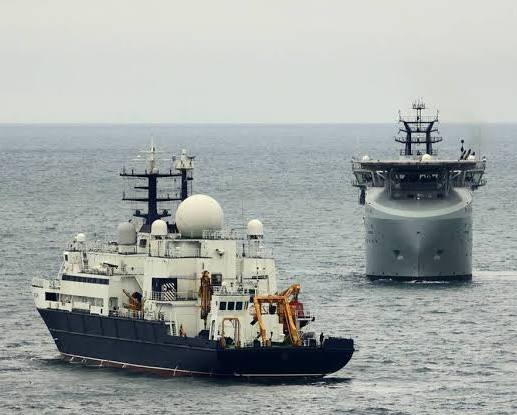
Britain has watched her more closely since. In November 2024, HMS Tyne tracked her in the Irish Sea, and Defence Secretary John Healey later revealed that he had ordered a Royal Navy attack submarine to surface near her. In January 2025, HMS Somerset launched a Merlin helicopter that located her heading north. The frigate intercepted her at the entrance to the Channel, south of Ushant, and followed her through the Strait of Dover. The Navy called it “routine business”. Healey called her a spy ship used to map British underwater infrastructure, yet conceded she had so far complied with the rules of navigation. By November, she was back, north of Scotland, and Britain accused her crew of aiming a laser at a surveillance aircraft.
The Yantar draws a frigate and a patrol aircraft every time she comes. A trawler draws no one.
Other European governments grew uneasy about the civilian fleet. The Netherlands barred Russian fishing vessels from its ports in 2024 after a Dutch investigation pointed to spying. In May 2025, the EU listed two Murmansk firms, Norebo and Murman Seafood, over vessel movements it considered inconsistent with ordinary fishing. Norway followed in July. Both companies deny any wrongdoing. Norebo took Norway to court, and a Norwegian court has since ruled the sanctions valid.
On 9 April, Healey said British and allied forces had tracked an Akula-class attack submarine and two GUGI spy submarines for more than a month. London sanctioned GUGI in 2025. Healey described the Akula as a likely decoy meant to draw attention away from the other two, and said there was no sign of damage. Russia’s embassy called his account impossible to believe or verify.
Seen together, the ship, the submarines and the trawlers cover the same ground at three levels of visibility.
Why a trawler
The appeal is partly legal. No British law bars a foreign vessel from sailing slowly over a cable in international waters, and a trawler doing so looks like a trawler. Russia’s 2022 maritime doctrine, meanwhile, calls for “mobilised capabilities” of fishing and special vessels and for compensation to firms that lend property to the armed forces in peacetime. The Telegraph reports that the FSB can lean on civilian shipping firms, as the KGB did in the Cold War.

The firms already sanctioned elsewhere in Europe are not marginal. Norebo and Murman Seafood control about 40 per cent of the Barents Sea cod quota. The Telegraph does not tie its 17 vessels to either company. NATO’s James Appathurai has described a wider effort: a paramilitary structure, officially labelled research, that maps cables and pipelines. A survey is not an attack. But mapping is what an attack on a cable would need first, because the routes are public and the exact seabed positions are not.
What is at stake on land
The consequences are easier to picture away from the ocean. In October 2022, the Shefa-2 cable was cut and about 22,000 Shetlanders lost connectivity. Police believed a fishing vessel was responsible, not sabotage. Repairs took days, and backup routes helped.
Taiwan’s Matsu islands had less luck. In early 2023, two cables were cut within a week, leaving some 14,000 residents without reliable internet, and Taipei suspected Chinese vessels without calling it deliberate. The islands spent roughly a month cut off, partly because there are few cable-laying ships to send.
Both episodes had the same ingredients: a fishing boat, a cable, no proof of intent. That is no accident of history. Fishing gear and anchors are behind roughly 70 to 80 per cent of all cable faults worldwide, which is exactly why a deliberate act would be hard to prove. Scale that to the Atlantic, and the numbers become uncomfortable. Around £65bn of UK economic activity rides on the transatlantic links, and two cables carry about three-quarters of the capacity.
Then there is the question of sovereignty. Much of the cables’ length lies outside waters Britain controls, so the state cannot police the seabed it depends on, and the worry is interception as well as outage. That anxiety is already reshaping the state’s relationship with private operators: the white paper would let ministers direct cable and repair companies on national security grounds and, according to TelecomTV, order telecoms firms to shut off connectivity. It is also the terrain of hybrid warfare, pressure designed to stay below the threshold of armed conflict, a style that analysts say Russia has refined. NATO has said such attacks could in theory trigger its Article 5 collective defence clause, and Germany’s intelligence chief warned in 2024 that the risk of it doing so was rising.
A hole in the net
Britain’s answer is the law. On 22 October, London published a white paper proposing up to 14 years in prison for deliberate damage to cables, ten for reckless damage and two for gross negligence, with a 12-week consultation now open. Telecoms minister Ian Murray told the Telegraph the law would deter the commercial proxies, not Moscow itself.
The sanctions trail is thinner than it looks. London has listed GUGI, but not Norebo or Murman Seafood. And the industry those firms belong to is hard to hurt, because Britain still eats its produce. Since 2022, a 35 per cent tariff has applied to Russian seafood, but not to Russian-caught fish substantially processed in another country. Imports from Russia fell 59 per cent in a year while imports from China, a common processor of Russian whitefish, rose 11 per cent. Industry figures put Russian-linked whitefish entering Britain at around £100m a year, some of it ending up in fish and chip shops. In this way fishing trawlers are either spying either supporting russian economy, and by extent the agression of Ukraine.
Britain can name the trawler. It cannot yet trace the fillet. In the same month London proposes years in prison for those who cut a cable, the cod that funds the boat still clears customs.


