


Chinese platform Weibo ; non identified author
China’s emerging fleet of submarine-drone motherships could strengthen the People’s Liberation Army Navy’s capacity to deploy and sustain extra-large uncrewed underwater vehicles (XLUUVs) far from fixed bases such as the AJX002 and the HSU100. The identification of a second specialised vessel under construction at Guangzhou Shipyard International, following a larger prototype of Hudong-Zhonghua in Shanghai, points to parallel development of platforms designed to transport, launch, recover and service these autonomous submersibles. If confirmed, the program would give China greater flexibility to operate underwater systems across contested maritime regions, including the South China Sea and waters around Taiwan. Although the program can’t be declared operational, it indicates an effort to build the logistical infrastructure needed to expand China’s undersea reach and potentially increase the pressure it can exert on regional adversaries.
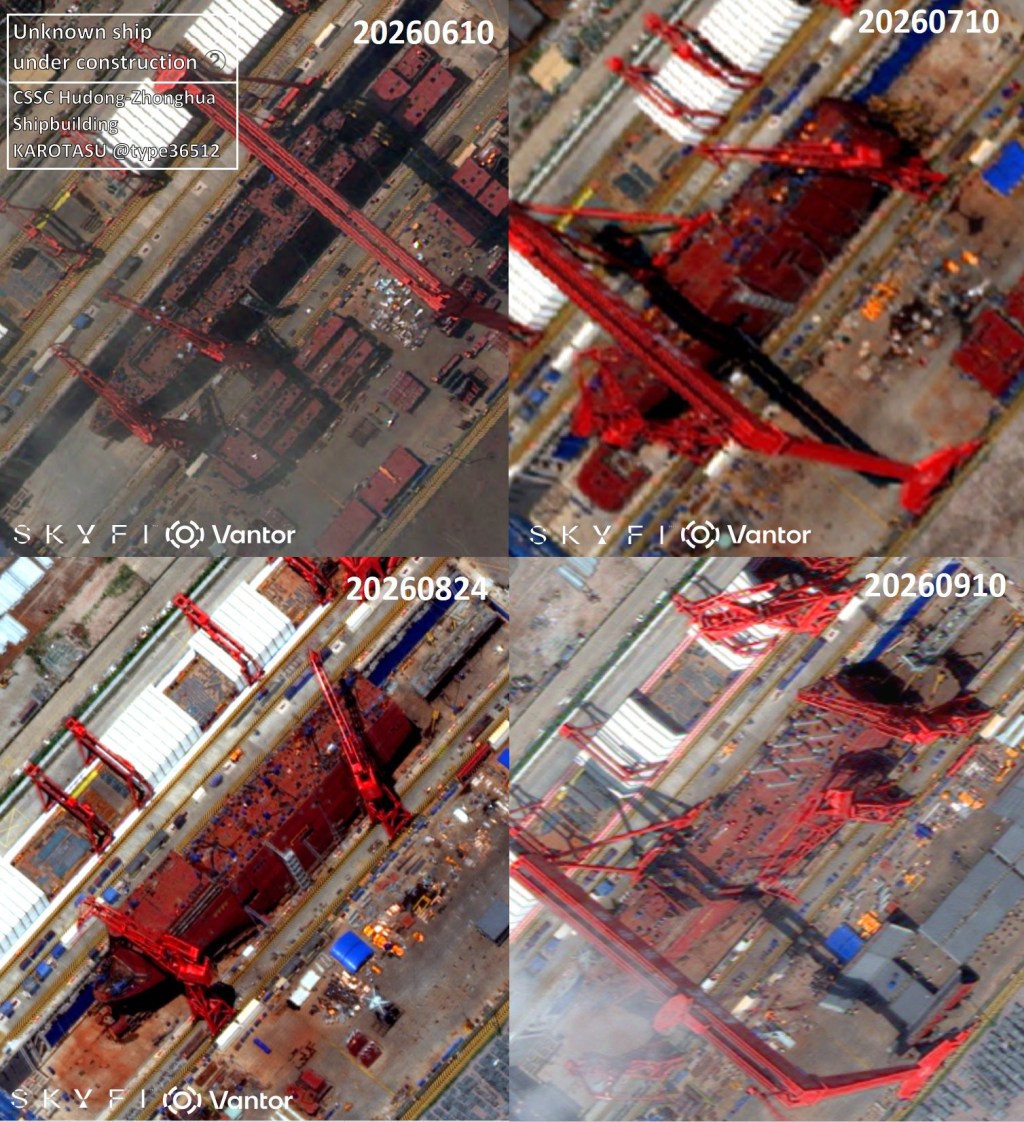
The role of submarine mother ships : functioning as a mobile platform
Operating massive autonomous submersibles presents unique logistical challenges. While smaller drones can easily be transported by road and launched via truck-mounted cranes, extra-large underwater unmanned drones (XLUUVs) can span 35 to 45 meters in length plus a range of nearly 10 000 nautical miles, which is approaching the performances of traditional midget submarines. Until recently, testing and deployment required rigid port infrastructure or specialised floating docks, which typically restrict operations to a single vehicle at a time and tie the fleet close to fixed bases.
A dedicated mothership bypasses these constraints by functioning as a mobile, ocean-going platform. These vessels are engineered to carry, launch, service, and recover multiple heavy submersibles across great distances. By transporting drones covertly to remote operational zones, such as distant blue-water choke points or contested regional seas, a mothership preserves the battery life and endurance of the submersibles, sparing them thousands of miles of independent transit. Once a mission is complete, the mothership can also provide enclosed dry maintenance hangars to service the complex machinery out of sight.

The Shanghai prototype
To understand the scope of this program, it is necessary to look back at the first major development. Earlier in the autumn of 2026, commercial satellite imagery revealed (LINK) an unprecedented 200-meter vessel under construction at the Hudong-Zhonghua shipyard on Changxing Island in Shanghai. Widely assessed as the world’s first dedicated mothership for giant unmanned submarines, the Shanghai prototype features a box-like superstructure reminiscent of a massive roll-on/roll-off cargo vessel. Its most striking design element is an open-bottom well deck at the stern, measuring roughly 55 meters long on a vessel approximately 200 meters long, equipped with an intricate system of 12 vertical jack-up arms. This elevator move lowers into the water to receive a massive drone and lifts it securely into an internal dry hangar space capable of housing multiple heavy submersibles.
The second wave: the Guangzhou variant
The newly revealed vessel spotted in Guangzhou introduces an alternative design philosophy. Built by China State Shipbuilding Corporation (CSSC) affiliates, this second hull is noticeably more compact, measuring approximately 150 meters in length which is roughly one-third smaller than its Shanghai counterpart. While retaining a stern well-deck architecture for handling heavy payloads, the Guangzhou variant features a modified configuration utilizing six vertical lifting pillars instead of twelve.
The Chinese model: internal competition in a highly coordinated industrial space
The decision to build two different designs simultaneously across two major shipyards reflects a deliberate strategy of parallel development. Rather than committing immediately to a single platform, the People’s Liberation Army Navy (PLAN) with a close cooperation with state-linked firms frequently builds competing working prototypes to conduct real-world side-by-side evaluations. This approach allows planners to compare how different hull sizes and mechanical lifting arrangements perform during trials, which explains the difference in size and mechanism.
By testing both configurations in parallel, Chinese shipbuilders can identify potential engineering issues and refine operational requirements early in the trial process. China’s vast industrial shipbuilding ecosystem and integration between commercial and naval yards make it feasible to absorb the costs of running simultaneous prototype lines. Once operational trials determine the most effective design, production can be scaled rapidly across existing shipyard facilities.
Geo strategic implications
The emergence of these specialised motherships marks a notable shift in how China can project coercive undersea power across contested regional waters, particularly in the South China Sea and around Taiwan. By providing a mobile, floating maintenance hub, these surface tenders allow the PLAN to maintain a persistent underwater presence directly inside key maritime choke points such as the Taiwan Strait, the Bashi Channel, and the Miyako Strait, providing potential access to areas beyond the so-called first island chain without relying on fixed regional bases.
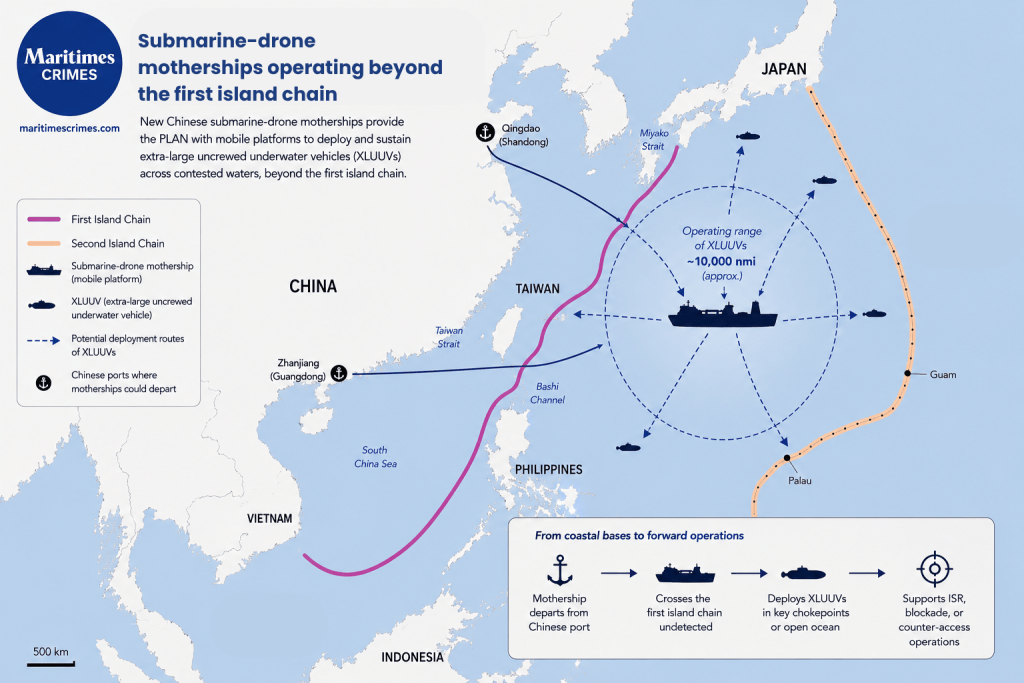
In a high-intensity crisis or blockade scenario around Taiwan, motherships carrying extra-large autonomous submersibles can change and hide the provenance of Chinese projection force. The mothership could act as a mobile submarine tender for the XXLUUV all around the globe.
In a scenario involving the US, the vessels could support long-range undersea operations, potentially including deployment off the west coast of the United States during periods of heightened tension or conflict, Naval News supposes. What is clear, however, China continues to invest in developing the operational capabilities needed to deploy these systems is that China continues to invest heavily in their operationalisation, developing the means to deploy unmanned submarines globally.
Sources & Bibliography
- Naval News: Alex Luck, “Second Possible Chinese Uuv Mothership Appears in Guangzhou,” October 18, 2026. Available at: Naval News
- The War Zone / TWZ: Tyler Rogoway et al., reporting on the emergence of the second submarine drone mothership, October 2026. Available at: The War Zone
- Defense WarRoom: Thomas Kerval, “China’s Second Suspected UUV Mothership Seen in Guangzhou,” October 18, 2026. Available at: Defense WarRoom
- H.I. Sutton (Covert Shores): Analysis on China’s innovative uncrewed submarine mothership and the Shanghai Hudong-Zhonghua construction, September 2026. Available at: H.I. Sutton
- Forum Militaire & China Defense Blog: Analysis on Chinese production lines for unmanned fleet support vessels, October 2026. Available at: Forum Militaire and China Defense Blog


