


The arrival of USS Theodore Roosevelt (CVN-71) in the Middle East brings a third American aircraft carrier into a region already under intense military pressure. With Washington maintaining its naval blockade of Iran and expanding its interdiction campaign, the deployment raises a pressing question: is the United States preparing for another escalation, or is this simply a carrier rotation?
Officially, the movement appears consistent with plans to relieve USS George Washington (CVN-73). But the temporary concentration of three carrier strike groups gives Washington formidable military options at a moment when diplomacy remains fragile and commercial shipping faces growing uncertainty.
For the Arabian Sea and the Strait of Hormuz, the stakes extend far beyond military manoeuvres. A renewed confrontation could put merchant vessels, civilian crews, energy infrastructure and the marine environment directly in harm’s way.
USS Theodore Roosevelt moves into a tense Middle East
The Theodore Roosevelt Carrier Strike Group departed Singapore on 8–9 November 2026, heading west through the Strait of Malacca and across the Indian Ocean.
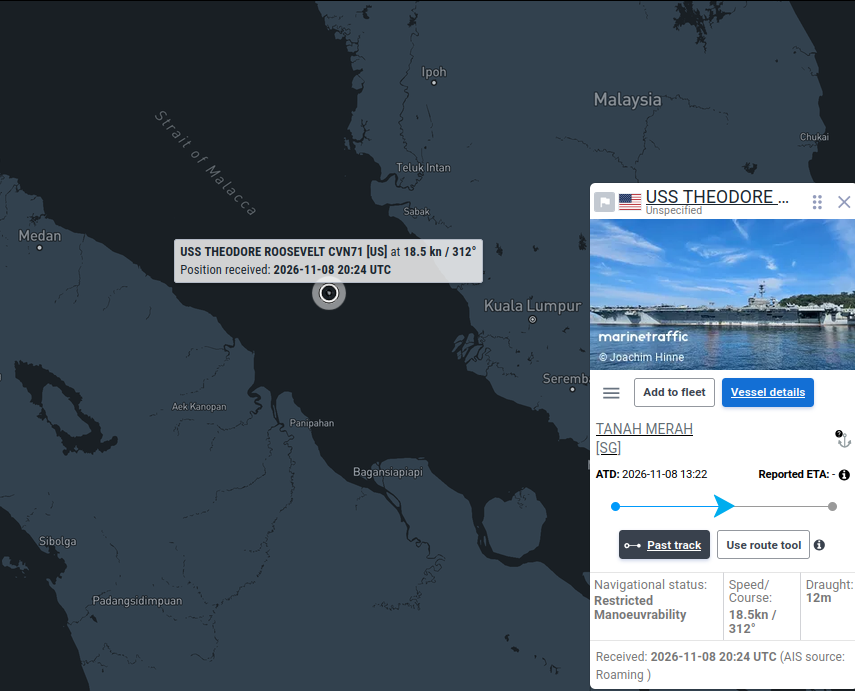
According to a report by Gulf News, the carrier entered United States Central Command’s (CENTCOM) area of responsibility on 15 November. Its precise position in the Arabian Sea has not been publicly confirmed.
The nuclear-powered Nimitz-class carrier leads Carrier Strike Group 9, with Carrier Air Wing 11 embarked. Its reported accompanying vessels include:
- USS Chosin (CG-65), guided-missile cruiser
- USS Decatur (DDG-73), guided-missile destroyer
- USS Paul Hamilton (DDG-60), guided-missile destroyer
However, not all these ships continued towards the Middle East. According to USNI News, USS Paul Hamilton sailed east into the South China Sea after the Singapore port visit, while USS Theodore Roosevelt, USS Chosin and USS Decatur headed west.
Two other American aircraft carriers, USS George H.W. Bush (CVN-77) and USS George Washington (CVN-73), were already operating in the wider region.
Estimates of American naval strength vary according to the geographical area and reporting date. An assessment by Israel’s Institute for National Security Studies identified approximately 17 US warships within CENTCOM’s area of responsibility before accounting for the incoming carrier group.
Three carriers do not automatically mean three sustained deployments. But even a temporary overlap represents a significant concentration of American naval aviation near Iran.
Three aircraft carriers: routine rotation or a warning to Tehran?
An aircraft carrier is more than a floating airbase. Supported by its embarked aircraft, destroyers and cruisers, it provides the United States with substantial strike, surveillance and defensive capabilities.
Three carrier strike groups in the same regional theater would give Washington considerable flexibility to sustain air operations, reinforce the blockade and respond to threats.
Yet the most important question is whether this naval concentration is temporary. The USS Theodore Roosevelt was expected to relieve USS George Washington, deployed to the Middle East since August.
A Reuters report reinforced that assessment. Sources familiar with US planning indicated that the third carrier was moving towards the region to replace one of the two already deployed, although Washington could retain all three if necessary.
This distinction is crucial.
A short overlap would be consistent with maintaining continuous military coverage during a planned handover. An extended three-carrier presence, however, would suggest a more substantial commitment of American forces. For now, the arrival of USS Theodore Roosevelt is not evidence that another offensive has been ordered.
The clearest signal will come from what happens next: does USS George Washington leave, or does Washington keep three carriers near Iran?
Iran under pressure: Naval blockade, Iron Gate and fragile diplomacy
The deployment comes amid the US-Israeli conflict with Iran, lasting since February 2026. Washington has since maintained a naval blockade targeting commercial traffic linked to Iranian ports, seeking to restrict Iranian revenue, military supplies and strategic imports.
The pressure is no longer confined to the sea.
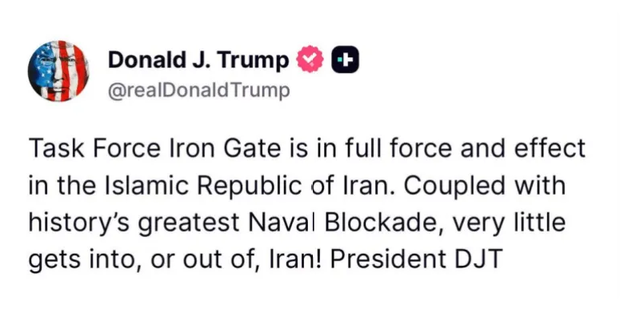
On 8 November, CENTCOM announced Task Force Iron Gate, an initiative designed to extend interdiction efforts to land routes and the Caspian Sea, targeting weapons transfers, dual-use technologies and sanctioned supplies.
Together, the blockade and Iron Gate form a wider campaign intended to constrain Iran’s military capabilities and economic connections.
The Arabian Sea and Gulf of Oman have become central to this confrontation. They provide access to the Strait of Hormuz, one of the world’s most strategically important maritime chokepoints.
Yet military pressure is unfolding alongside diplomatic efforts to prevent renewed strikes.
Reuters reported on 14 November that President Donald Trump had told advisers he might hold back further attacks unless Iran or the Iran-backed Houthis carried out new provocations. Saudi Crown Prince Mohammed bin Salman and Turkish President Recep Tayyip Erdoğan reportedly urged restraint, while Israeli officials continued to favor renewed military action.
Washington is therefore maintaining a powerful military presence while leaving room for diplomacy.
The arrival of USS Theodore Roosevelt strengthens its options, whether for deterrence, blockade enforcement or renewed operations. But a stronger military posture also increases the consequences of any miscalculation.
Arabian Sea on edge: The risks extend far beyond the battlefield
The arrival of a third American aircraft carrier raises the stakes in one of the world’s most sensitive maritime corridors. The Arabian Sea, Gulf of Oman and Strait of Hormuz are vital to global shipping and energy supplies. A renewed confrontation could rapidly disrupt commercial traffic, expose civilian crews to attacks and complicate the passage of vessels already affected by the US blockade.
The danger extends beyond shipping delays. A strike on an oil tanker or commercial port could cause civilian casualties, trigger a major oil spill and damage coastal ecosystems. Naval interdiction also raise questions under international law, particularly concerning neutral shipping, civilian protection and the legality of attacks on merchant vessels.
USS Theodore Roosevelt’s arrival may ultimately prove to be a routine rotation. But with three American carriers near Iran, the margin for miscalculation is narrowing and tensions are growing. A single incident could turn a military confrontation into a wider maritime, humanitarian and environmental crisis.


