


Aerial Top down view Black Sea port : loading of dry cargo ship with Ukrainian grain by cranes. Credit: Glebzter/Shutter shipping attacks
Since Russia’s full-scale invasion of Ukraine in February 2022, the security of Ukrainian export routes has been a major concern for agricultural markets and international food supplies. Now, as attacks on commercial vessels increase the risks to maritime traffic, embodied by nearly ten drone-attacks over the past month, as previously reported by Maritimes Crimes. Now, Kyiv is seeking a new diplomatic arrangement to restore civilian navigation. On 18 October, Ukrainian President Volodymyr Zelenskyy discussed a possible grain corridor with Türkiye, India and Egypt. While Bulgaria and Romania are calling for a NATO response mechanism, the diplomatic proposal would seek to protect commercial vessels flying the flag of participating countries as they approach Black Sea ports.
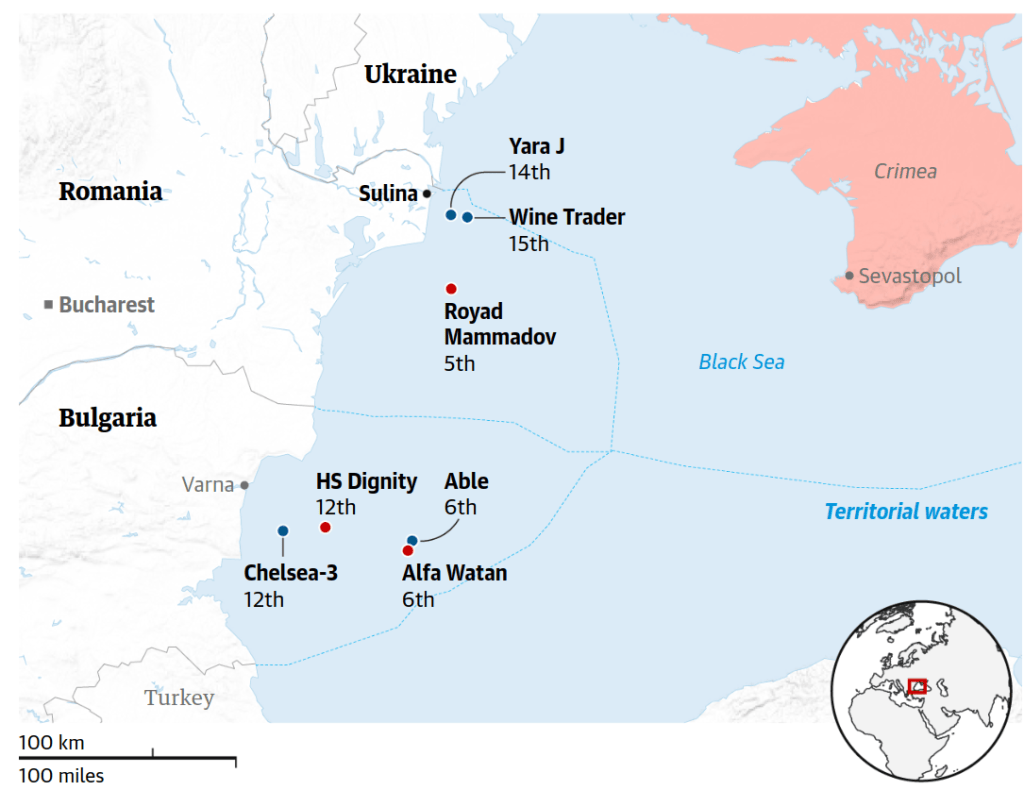
In recent weeks, the safety of merchant shipping has become more difficult as attacks and drone activity have spread across the western Black Sea. Six attacks have been reported in nearly ten days, this escalation is very likely linked to Russian forces, according to a source of the Guardian. Concerns are therefore rising over the exposure of commercial vessels operating near the war zone reporting on the incident. As attacks persist, on 18 October, Romanian F-16 fighter aircraft shot down two drones over the country’s territorial waters. According to Reuters, Romanian authorities said the drones were likely Russian-made Geran-4 models.
Ukraine relies heavily on its Black Sea ports to export agricultural products. According to Bloomberg’s report, the chain of ports can handle up to 40 million tonnes of grain during a marketing season. Shipments have been halted since last august amid attacks targeting port infrastructure and vessels, leaving Ukraine again unable to allocate its usual maritime export volumes trough rail transport alone.
The initiative follows the collapse of the Black Sea Grain Initiative, brokered by the United Nations and Türkiye. Before Russia withdrew from the agreement in July 2023, nearly 33 million tonnes of food were shipped from Ukrainian ports to international markets in twelve months of implementation, the Joint Coordination Centre (JCC) established to monitor the deal said.
The newly proposed arrangement would establish reciprocal assurances for vessels sailing under the flags of participating countries. Ships traveling to Ukrainian and Russian ports would be protected under an agreement prohibiting attacks on them according to Zelenskyy.
The involvement of Türkiye, India and Egypt reflects the international importance of maintaining food shipments through the Black Sea. Kyiv is also seeking European Union support to revive its Solidarity Lanes, which facilitate Ukrainian exports through European roads, railways and ports. These routes provide an alternative when maritime transport is disrupted, although they cannot fully replace the capacity of Black Sea shipping.
For now, the proposed corridor remains a diplomatic initiative rather than an operational agreement. The implementation’s lean way depends on the parties’ ability to cooperate despite the Russian pressure, and ensuring that commercial vessels can use the route safely.
Black Sea disruption puts pressure on grain trade

From the port of Solina, passing along Bulgarian territorial waters, the scope of Russian attacks is larger than usual, exposing the Black Sea area and crystalizing the entire shipping road. Ukraine remains a significant agricultural exporter, and its access to maritime routes affects a critic flow for both Ukraine and dependent countries.
The disruption has prompted buyers to seek supplies elsewhere. An S&P Global analysis reported that grain buyers were looking to alternative origins as Black Sea instability continued. Egypt, a major wheat importer, faces particular exposure to changes in supply and transport costs, while Türkiye and Bangladesh have also been exploring alternative sourcing options. According to the Guardian, insurance prices’ harsh rise, for the Black S ea passage, are representative of the blockade provoked by the recent geopolitical ramifications.
Domestically, the stakes for Ukraine are heavy. Agricultural exports provide income for producers and foreign-currency revenue, while port activity supports jobs and related industries. A prolonged interruption to maritime trade would leave the country more dependent on routes that are less able to carry the same volume. This vulnerability targeting illustrates the hybrid strategy designed by the Russian forces, by attacking particularly merchant vessels, they seek to tackle the economic resources necessary to sustain the Ukrainian society.
Alternatives have been explored since the war’s outbreak, with notably the Solidarity Lanes established by the European Union states, corresponding to a ground-based redirection through railway lines of the Ukrainian grain export. European Commission reports showed that around 90% of Ukraine’s grain and oil seed-related exports were moving through the Black Sea, while approximately 10% used the EU’s Solidarity Lanes. The effort of land-based alternatives remain necessary, but results are also showing that they cannot simply replace maritime exports at the same scale, making ultimately,the renewing of a maritime corridor agreement increasingly important
Reconstruct the grain maritime corridor : Kyiv’s new diplomatic challenge
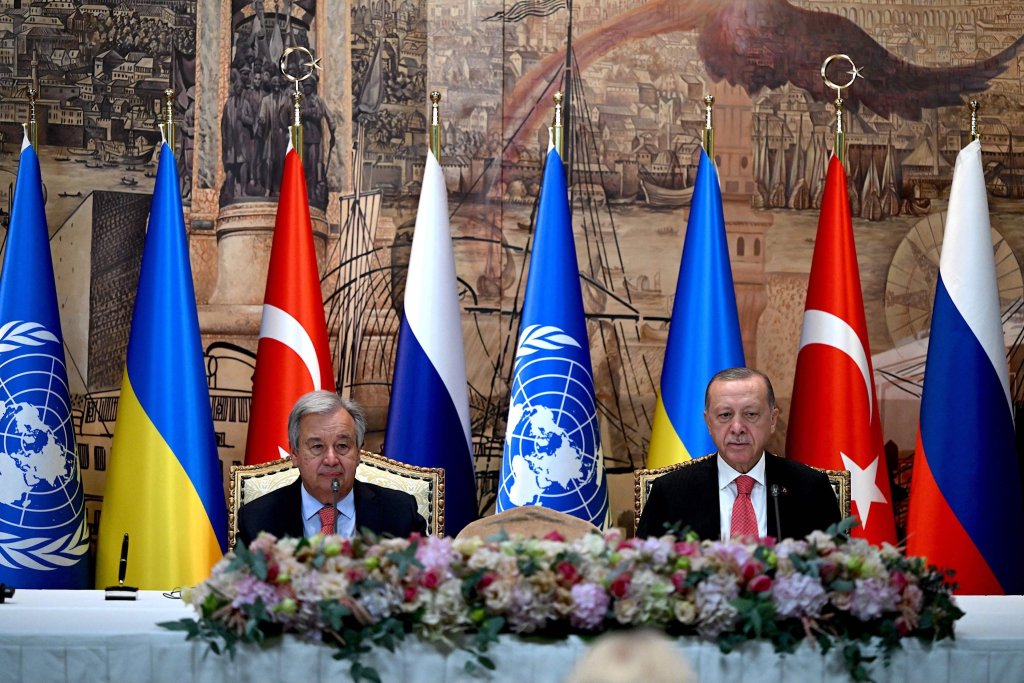
The proposed corridor faces a central obstacle: Russia could sea its ability to disrupt Ukrainian maritime exports considerably limited. Moscow has previously withdrawn from the grain initiative and has argued that restrictions affecting banking, insurance and shipping have hindered its own agricultural exports. A new arrangement would need to address commercial access while establishing credible guarantees for civilian vessels for both sides. The United Nations’ record of the earlier Black Sea Grain Initiative provides context for the scale of the trade that a renewed agreement might support.
Europe’s response is taking shape beyond the grain proposal. In May 2025, the European Union proposed a Black Sea Maritime Security Hub to improve information-sharing, monitor critical infrastructure and strengthen early warning of maritime threats. A further step came in 2026, when Romania and Bulgaria developed a concept for a regionally coordinated hub with EU support. The European Commission’s 2026 update outlines the initiative, which is intended to improve maritime awareness and strengthen protection for infrastructure and shipping. Such cooperation could help identify threats, and serve as an intermediary measures to complete the corridor, as it would not itself guarantee safe passage.
However, regional interests also differ. Romania and Bulgaria want to protect their coastlines and keep export routes operating, while Türkiye’s control of the straits is used as leverage to reinforce it as central actor in Black Sea access. Under the Montreux Convention, merchant vessels enjoy freedom of passage subject to the convention’s provisions, while warship passage is governed by specific restrictions. Türkiye therefore has an important role in shaping any measures to enforce this freedom of passage. It’s worth noting that its position has also evolved by concern over the safety of navigation, and, more importantly, bye the risk that the conflict could spread further across the region, taking the stance of a regional balancing power.
The corridor’s success will depend on whether the countries involved can agree on credible guarantees for commercial shipping, the diplomatic initiative will need to be translated into practical measure. At the same time, another set of solutions are emerging, more coercive : Romania has used F-16s to intercept drones over its territorial waters, while Romania, Bulgaria and Türkiye have expanded regional mine-countermeasure cooperation to address threats to maritime infrastructure. While diplomatic path is still in talks, the NATO countries in the region seem to expect a military-inclined solution, Bulgaria has expressly sought additional NATO support for counter-drone defence, as stated the Bulgarian defence minister Dimitar Stoyanov. However, no dedicated NATO naval escort for Ukrainian grain ships has been publicly confirmed and it remains unclear if a NATO mechanism would complete the diplomatic corridor or a competing solution with probably a different scope of action. Finally, these steps strengthen regional defence and monitoring, but securing a new grain corridor will ultimately require an arrangement, taking an acceptable shape for the parties involved, that allows merchant vessels to operate without attack.


