


Since November 2023, Houthi attacks on merchant vessels have turned the southern Red Sea and the Gulf of Aden into a contested seaway. In response, the European Union launched Operation Aspides on 19 February 2024, a purely defensive naval mission designed to safeguard freedom of navigation and provide close protection to merchant shipping. France is among the core contributors, and its warships have already neutralised aerial and surface threats while conducting rescues under fire. This analysis reviews Aspides’ mandate, methods and results to date with a focus on the French Navy’s actions and assesses the operation’s stakes for global trade and maritime safety.
From the galaxy leader to a systemic threat to navigation
The current crisis began with the helicopter-borne seizure of the car carrier Galaxy Leader on 19 November 2023, when Houthi fighters boarded the ship in the southern Red Sea and took 25 crew members hostage a spectacle broadcast in a widely circulated video. The crew were released in January 2025 after more than a year in captivity, following Omani mediation. The hijacking and subsequent attacks transformed a long-standing regional risk into a sustained campaign against commercial traffic.
By early 2024, the disruption was visible in trade flows: Suez Canal transit volumes fell by about 50% year-on-year in January–February 2024, while rerouting around the Cape of Good Hope surged. Through May 2025, UNCTAD estimated Suez transits were still ~70% below 2023 averages. Given the canal’s usual share roughly 10–12% of world trade and ~30% of global container traffic the macroeconomic implications are evident.
Operation Aspides: mandate, area and legal framing
Aspides was launched by Council Decision (CFSP) 2024/632 with an initial one-year duration and a strictly defensive remit: accompany and protect merchant vessels, reinforce maritime situational awareness, and no strikes on land. The area of operations spans the Red Sea, Bab al-Mandab, Gulf of Aden, Arabian Sea, Gulf of Oman and the Gulf, with operational headquarters in Larissa, Greece. On 14 February 2025 the Council prolonged the mandate to 28 February 2026.
The operation’s legal and diplomatic context is anchored in UN Security Council Resolution 2722 (10 January 2024), which condemns Houthi attacks on merchant shipping and underscores the importance of navigational rights. Aspides’ defensive posture explicitly contrasts with U.S./U.K. strike campaigns; the EU mission focuses on convoying/escorts and point defence in accordance with the law of the sea.
Aspides coordinates closely with EUNAVFOR Atalanta (anti-piracy/illicit flows) and benefits from Council adjustments to Atalanta’s legal framework in July 2025 to facilitate support along overlapping routes. This aims to reduce seams between missions as threat vectors diversify from piracy to drones, missiles and USVs.

The French Navy at the sharp end: drones, missiles and rescue under fire
France has been continuously engaged under Aspides with air-defence frigates and FREMM multi-mission frigates. During the night 19–20 March 2024, the FREMM Alsace faced multiple threats in the Gulf of Aden/Red Sea: her embarked Panther helicopter shot down a Houthi UAV with 7.62 mm fire, and within 24 hours Alsace intercepted three incoming missiles using Aster surface-to-air missiles demonstrating layered air defence from rotorcraft door-gunner to long-range SAMs. The French defence ministry and specialist outlets documented the engagement as the ship’s “trial by fire.” defense.gouv.fr+2Naval News+2
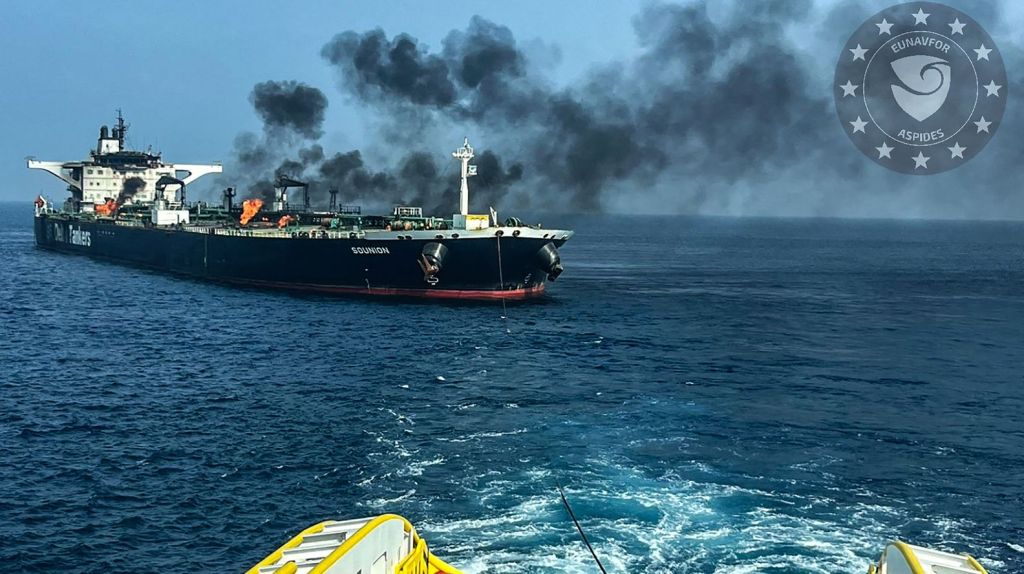
On 21 August 2024, the Greek-flagged tanker Sounion was set ablaze after being hit by Houthi munitions. Responding to a distress call, the French air-defence frigate Chevalier Paul rescued the crew and destroyed an approaching explosive USV during the operation an episode later cited by EUNAVFOR and industry media. The damaged tanker posed a major spill risk (about 150 000 t of crude), but a complex salvage under Aspides’ protection ultimately averted an environmental disaster.
French ships have continued to counter aerial threats into 2025. In April 2025, the defence minister announced a French frigate intercepting a drone launched from Yemen, with imagery subsequently released by the armed forces. These incidents underline the intensity and variety of threats ranging from small, slow UAVs to faster ballistic or cruise missile volleys and the need for constant readiness.
How protection works: demand, capacity and the ‘close protection’ model
Aspides provides close protection to merchant vessels on request, coordinated through MSCHOA/NCAGS channels; eligibility and routing advice are communicated to shipowners and masters, and assets are allocated when available. This escort-on-demand model is tailored to a vast theatre and a dynamic threat picture, but it also creates queues and scheduling friction when naval assets are limited.
By June 2025, the operation had protected roughly 476 ships according to the Operation Commander in a Reuters interview, while another official tally noted that in its first year Aspides supported over 640 merchant ships, with 370+ receiving close-protection escorts the variance reflecting different counting methods (“supported” vs “escorted”). Senior officers have repeatedly requested more EU hulls to match demand across a sea area “twice the size of the EU’s territory.”
Traffic has partially recovered as targeting patterns evolved, but remains below pre-crisis levels. The EU commander reported 36–37 ships/day using the narrow Bab al-Mandab in early June 2025, up from 20–23/day at the trough in August 2024, yet still far short of 72–75/day before the attacks. Limited escort capacity often 2–3 EU warships on station—remains the binding constraint.
What the Red Sea crisis did to global logistics and why escorts matter
Rerouting via the Cape of Good Hope added 14–25 days to many Asia–Europe voyages, raised fuel costs and insurance premiums, and pushed ton-miles (distance-adjusted demand) sharply higher in 2024. Even as carriers and shippers adapted, the persistent risk premium continues to feed volatility in spot rates and schedules. Escorts do not eliminate system-wide costs, but they restore predictable corridors for shippers unable to absorb Cape detours—energy cargoes, time-sensitive freight, and EU-bound industrial inputs among them.
Environmental stakes illustrated by Sounion
The Sounion incident crystallised the ecological dimension of this security crisis. With 150 000 t of crude aboard, uncontrolled burning or structural failure could have produced a far-reaching slick along the Yemeni coast and in the southern Red Sea’s sensitive habitats. The crew rescue and USV neutralisation by Chevalier Paul, followed by a multi-company salvage and relocation under Aspides cover, prevented a spill. The episode demonstrates the need for naval forces capable not only of air defence but also of on-scene coordination for SAR and environmental risk mitigation.
Europe’s posture: defensive by design, integrated in practice
Aspides’ design defensive, de-escalatory, legally conservative reflects the political balance inside the EU and the constraints of operating without an explicit UNSC Chapter VII enforcement mandate. Where Washington and London opted for land strikes, the EU has prioritised layered defence at sea and industry liaison with shipowners and insurers. This approach is slower to create deterrence but lowers escalation risk and aligns with the EU’s wider diplomatic posture on Yemen. Coordination with Atalanta has been tightened, with legal updates in December 2024 and July 2025 to streamline support along the same sea lines of communication.
Policy debates have also surfaced on consolidating EU maritime missions in the wider region to reduce duplication from the Gulf of Oman to the western Indian Ocean. While no formal merger has been decided, analysis from European think-tanks argues for a single architecture to manage hybrid threats across chokepoints.
Outlook: what to watch as Euronaval opens
As Euronaval convenes 4–7 November, three operational questions will shape Aspides’ next phase. First, mass: can the EU field enough high-end air-defence hulls and helicopters to provide continuous close protection and surge when salvos come in clusters? Second, integration: will the Atalanta Aspides interface, plus industry coordination via MSCHOA/NCAGS, keep improving to cut delay and uncertainty for owners? Third, resilience: can escorts, routing advice and diplomacy sustain the recent partial rebound in Bab al-Mandab transits without a relapse in attacks? With the mandate now extended to February 2026, France and its partners face a long haul in a theatre where tactical success intercepting drones, rescuing crews must translate into a durable strategic effect: the routine, lawful passage of ships through one of the world’s most vital arteries.


