Russian maritime forces no longer possess the logistical means necessary to renew their fleet. Impacted by the Montreux Convention, Russia’s fleet seems to be running out of breath as it is forced out of the Black Sea.
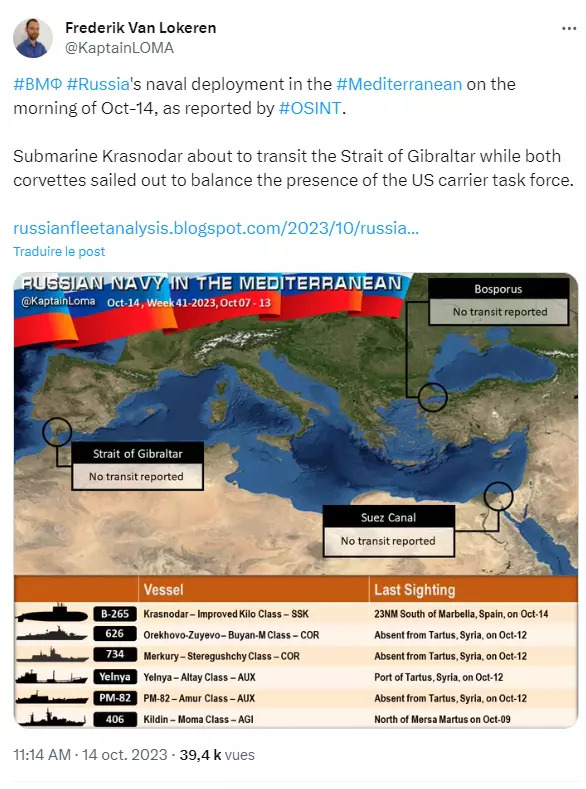
On Saturday October 14th for the first time in years, the Russian submarine Krasnodar – previously in the Mediterranean Sea – crossed Gibraltar’s strait. The Russian Military Maritime Fleet (VMF) does not have any submersible left in the Mediterranean since mid-October. According to Belgian naval analyst Frederik Van Lokeren , on X, the VMF would currently have five units left, namely two supply ships, two corvettes (“Orehovo Zuyevo” and “Merkury”) and an electronic warfare vessel (“Kildin”).
The Montreux Convention explains Russian fleet’s impediment in the Mediterranean sea. Since 1936, the international agreements made in the Swiss city have commanded free movement in the straits of the Bosphorus, the Dardanelles and within the Black Sea. The Convention, counting more than fifty signatory states, follows a long-standing geopolitical and strategic conflict in the area. For Turkish geopolitical analyst Yörük Işık: “These straits are real strategic nodes of Eurasia”, as they form the unique maritime routes between the Mediterranean and the Black Sea. These straits are closed to all warships since February 28th, 2022 as Ankara engaged in the Convention. It states that navigation must preserve the security of Turkey, the Black Sea and the coastal states. The closing of the Turkish straits keeps Russian ships from entering the Mediterranean.
Since the start of the war in Ukraine, Russia has already violated this agreement, as merchant ships are used as naval auxiliaries to provide logistics for operations in Syria and Ukraine.
A possible weakening of the Russian fleet
The closing of the straits keeps the Russian navy away from its home harbors, forcing it to only rely onto its Syrian support point (Tartous harbour). This strategic point represents the only logistical support remaining for the Russian fleet in the Mediterranean.
The lack of strategic support in such a large perimeter exhausts material resources of Russian ships (most of which suffer from serious damages). This might explain why the Krasnodar was spotted in Gibraltar’s strait while being towed by the Sergey Balk navy tug.
Middle Sea’s waters are no longer home to any Russian submarines since then as the Krasnodar was not replaced. Everything seems to indicate a weakening of the Russian navy in the Mediterranean, which can not count on sufficient logistical support points for the renewal of its fleet.
The Krasnodar has been confirmed to have crossed Gibraltar’s Strait, as it was seen in the south of Marbella, Spain. It could be now heading towards the Baltic Sea.
For many analysts, the submersible’s trajectory suggests a possible return to the homeland. A return that appears to be anticipated by Russian navy’s inability to renew its equipment while at sea.