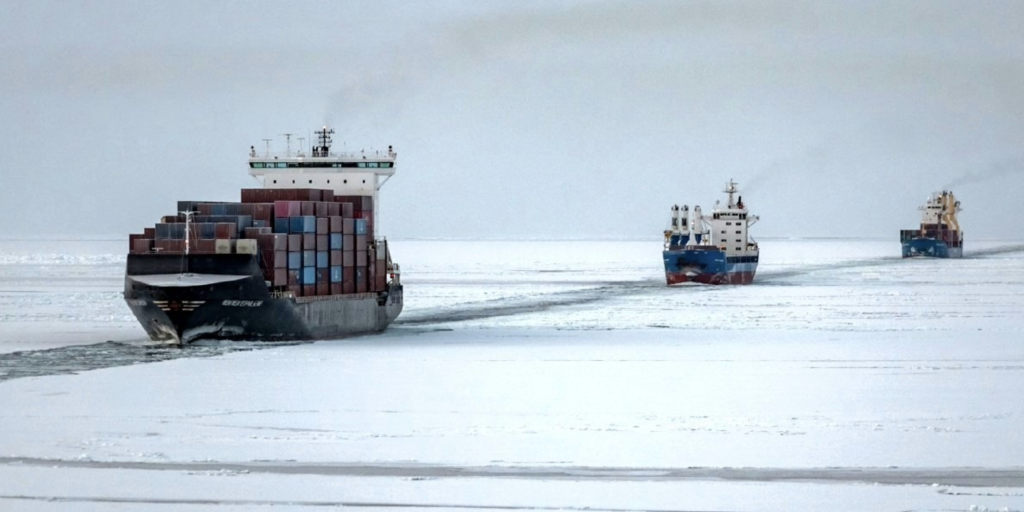
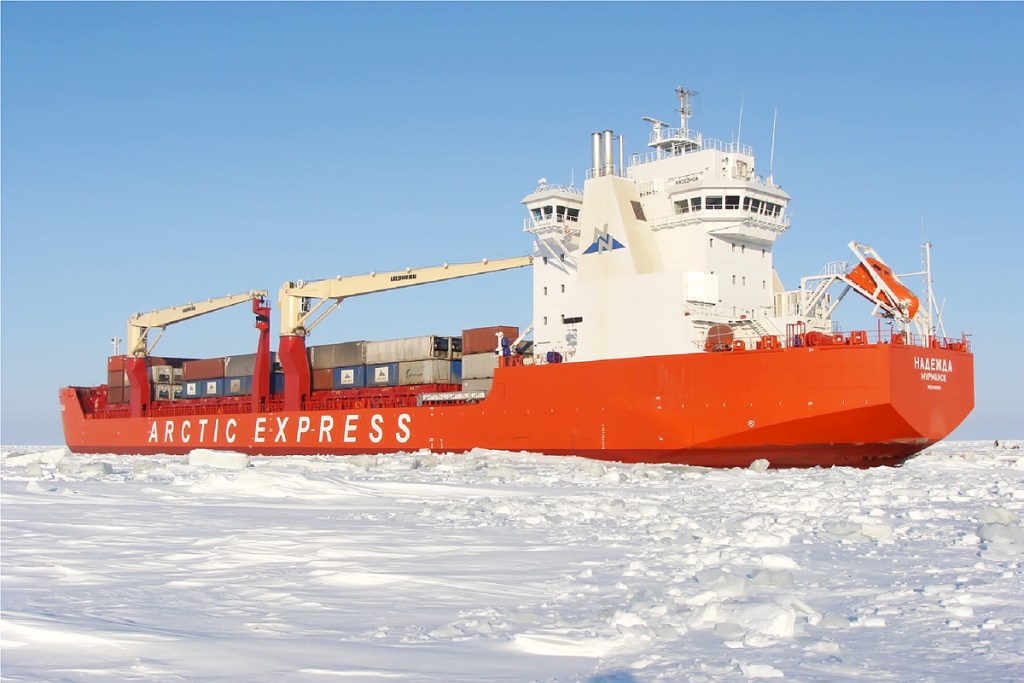
On September 22, the container ship Istanbul Bridge left the Chinese port of Ningbo-Zhoushan carrying nearly 4,900 containers bound for the United Kingdom. Its goal: to reach the port of Felixstowe in just 18 days by sailing through the Northeast Passage along Russia’s Arctic coast. This maiden voyage marks the launch of the “Arctic Express,” a regular China-Europe line that could reshape global logistics. Yet this achievement rests on a troubling reality: the accelerated melting of Arctic sea ice.
A new route driven by climate change
The journey from Ningbo to Felixstowe, which normally takes 40 days via the Suez Canal and over 50 days around the Cape of Good Hope, is now cut in half. Compared with China-Europe rail freight, which takes about 25 days, the Arctic Express offers a faster and competitive option. The route connects major Chinese ports – Qingdao, Shanghai, and Ningbo – with European hubs such as Rotterdam, Hamburg, and Gdańsk.
Such a regular service has only become possible because the ice is retreating. The Arctic is warming about four times faster than the rest of the planet, according to recent scientific studies. Where navigation was once impossible for most of the year, it is now feasible for nearly ten months annually. This climate disruption opens new commercial opportunities, but at the cost of one of the world’s most fragile ecosystems.

China’s polar silk road strategy
For Beijing, the Arctic Express is not just about faster logistics. Since 2017, President Xi Jinping has promoted the concept of a “Polar Silk Road” as part of China’s Belt and Road Initiative. A 2018 White Paper on Arctic policy confirmed this ambition.
Cooperation with Moscow is central to the project. Russia, which controls nearly half of the Arctic, provides the icebreakers required for safe navigation and hosts major Chinese investments, notably in the Yamal LNG gas project. For China, the route is a way to expand its geopolitical influence while securing an alternative corridor at a time when Suez and the Red Sea face mounting challenges.
Promises versus environmental risks
Supporters of the project highlight clear advantages. According to Sea Legend, the operator of the Istanbul Bridge together with Haijie Shipping, faster transit reduces business inventories by 40 percent and lowers costs. The timing is also strategic: goods, including electronics and e-commerce parcels, will arrive in Europe before the holiday rush when ports are usually congested. Chinese officials also argue that the Arctic passage could reduce CO₂ emissions by 30 to 50 percent compared with traditional detours.
But these promises face strong criticism. Several major Western shipping companies – MSC, Maersk, and Hapag-Lloyd – have ruled out Arctic routes. They cite poor infrastructure, the high cost of polar navigation, and above all the environmental risks. The Clean Arctic Alliance, a coalition of twenty NGOs, warns of pollution from vessels, including black carbon emissions from heavy fuel oil. When deposited on ice, black carbon accelerates melting. Environmental groups also point to the risks of oil spills, disruption of marine wildlife, and threats to local communities that depend on Arctic resources.
A strategic gamble with global impact
Amid growing pressure on traditional trade lanes, the Arctic may appear as an alternative. The Suez Canal is overloaded, the Red Sea is frequently targeted by attacks, and rail freight between China and Europe remains vulnerable to border disruptions. The Arctic, for now, seems more stable.
Still, the traffic is minimal. In 2024, only about 100 commercial transits were recorded on the Northeast Passage, compared with over 13,000 through the Suez Canal and more than 94,000 through the Strait of Malacca. For the moment, Arctic shipping is a niche market. Yet Beijing is betting on the long-term effects of climate change to gradually open up this corridor.
The Arctic Express embodies a paradox: what allows China to launch a new logistics axis today is also the most visible symptom of climate disruption. The question remains whether global trade can reconcile speed and efficiency with the preservation of the Arctic, one of the most vulnerable ecosystems on Earth.