


In 2024, a record total of 1,838 tonnes of illicit substances were seized worldwide, underlining the explosion in international trafficking. Among these seizures, 281 tonnes of cocaine were intercepted, with a significant proportion of this being transported by sea.
On March 15, 2025, the French Navy intercepted over 6,386 kilograms of cocaine, with an estimated street value of €371 million, off the Gulf of Guinea. The operation was conducted jointly with the DEA (United States), the NCA (United Kingdom), and the MAOC-N (Portugal). This seizure highlights the persistent and large-scale nature of international drug trafficking, particularly through maritime routes. In June 2024, another major event underscored this trend: the seizure of 24.5 tonnes of cocaine at the port of Hamburg, Germany—setting a new record. This surpassed the previous record set in July 2019, when U.S. authorities intercepted approximately 20 tonnes of cocaine aboard the MSC Gayane, a Liberian-flagged container ship docked in Philadelphia. That seizure remains one of the largest ever recorded, with an estimated market value exceeding $1 billion.
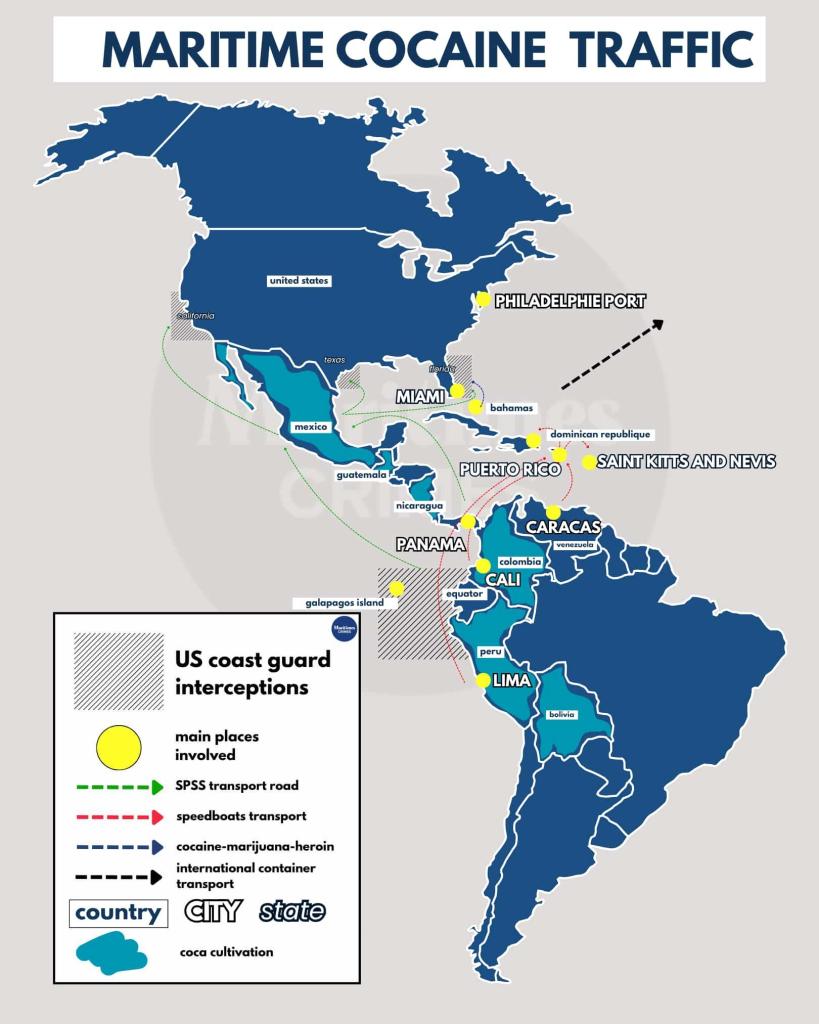
The sea route remains the cartels’ preferred means of transport. According to the latest report from the United Nations Office on Drugs and Crime (UNODC), global coca production is approaching 2,700 tonnes, with some 355,000 hectares under coca cultivation, the majority of which are located in South America. Colombia accounts for the highest area of cultivation, at 230,000 hectares (65% of the world total), followed by Peru (95,000 hectares – 27%) and Bolivia (30,000 hectares – 8%). There are also some residual production zones in Panama, Nicaragua, Guatemala and Mexico.
Rip-on/rip-off: cartel-style maritime cocaine trafficking
Cartels employ coercion or bribery to discreetly transport their merchandise to port. There are a variety of methods that can be used to conceal cargo aboard ocean liners, commercial fishing vessels, pleasure boats and speedboats.
One effective technique is to place the drugs in a container. One potential course of action would be to camouflage it within the cargo, forcing traffickers to use front companies. The process may also involve opening an already loaded container, inserting parcels or bags of drugs, and then replacing the customs seals with copies or clones to conceal any indication of tampering. This is known as the rip-on/rip-off method. The drugs are then placed in bags at the front of the container, in the refrigerated section or structure of the container, or in the middle of legitimate goods. In 2020, Costa Rican police made the largest drug seizure in their history, discovering five tons of cocaine concealed in 202 suitcases inside a container of flowers bound for the Netherlands. This is but one of thousands of examples.
Drop-off and SPSS: another method of maritime traffic
A further method involves informing traffickers of the containers that have already been inspected and their location, be that in the country of origin, transit or final destination. They are also informed where the drugs will be unloaded and recovered outside the port. Traffickers use geolocation devices to track their cargo and stay informed of any customs checks that may reveal illicit products.
Traffickers are known to utilise the drop-off technique, whereby drugs are dropped into the open sea for collection by small fishing boats. The next step is for them to unload the bags and contact the dealers on land, who will then distribute them throughout the network. This modus operandi is “typical of the most seasoned organised crime groups”, according to a magistrate.
Furthermore, traffickers are increasingly using self-propelled semi-submersibles (SPSS) to transport cocaine from South America to Mexico and the coasts of the USA. The use of SPSSs facilitates the discreet transportation of large quantities of drugs. These craft are generally only a few centimetres above the surface of the water, making them very difficult to spot visually. These vessels are typically crewed by four individuals and are capable of transporting several tons of cocaine. The US Coast Guard regularly intercepts them off the coasts of Texas, Florida and California.
Seaport: the gateway to drug trafficking
As production zones are located far from consumer markets, sea transport offers traffickers numerous advantages. These include flexibility of the vector, volume of cargo, low transport costs, regularity of connections and security loopholes in a globalised logistics chain.
However, the U.S. Drug Enforcement Agency (DEA) has stated that “the quantities of drugs brought directly into the United States by sea are less than those arriving by land”. However, precise figures are not available, as the authorities only monitor the volume of seizures, not exports. Traffickers utilise a variety of maritime routes to facilitate the entry of narcotics into the United States. Cocaine production is at levels that are almost equivalent to those in California, where the Coast Guard intercepted 11 shipments in two months. The Coast Guard has announced that 34 suspected traffickers have been arrested and over 48,000 pounds of cocaine and marijuana seized aboard speedboats off the coasts of Peru, Ecuador and the Galapagos Islands.
Colombia, Peru and Bolivia are transported by river and/or land to the main shipping ports. Cali (Colombia), Lima (Peru), Panama and Caracas (Venezuela). The route then continues on to Puerto Rico, Saint Kitts and Nevis, the Bahamas and the Dominican Republic.
It has also come to our attention that Caribbean traffickers are moving cocaine, heroin and marijuana from the Bahamas to South Florida, between Miami and Palm Beach. Since the beginning of 2025, the US Coast Guard has seized 22 tons of cocaine and two tons of marijuana worth $510 million off the Florida coast. These seizures, facilitated by the use of aerial drones, are comparable to those conducted in California, where the Coast Guard successfully intercepted 11 vessels over a two-month period. The Coast Guard successfully apprehended 34 suspected traffickers and seized a total of 48,000 pounds of cocaine and marijuana. This operation was conducted aboard speedboats in the coastal waters of Peru, Ecuador and the Galapagos Islands.


