


The military domain is characterized by the continuous evolution of technology. Naval technologies have advanced from the era of triremes to that of missiles, passing through the age of cannons. Today, experts predict that the era of robots will be next. Unmanned aerial vehicles (UAV) have demonstrated their effectiveness on the battlefield and are employed at all levels of command across all military branches.
The most prominent example is the ongoing Russo-Ukrainian war. UAVs have also made significant contributions to naval warfare. One key advantage of this technology is the tactical edge it provides to commanders at sea. This article will highlight one of the capabilities of drones that enables better control of maritime forces, ensuring their effectiveness in combating maritime crime.
Capabilities of UAVs
Experts often emphasize the use of UAVs for observation, equipped with high-resolution cameras that include thermal and infrared imaging. indeed, a keycapability of drones is Intelligence, Surveillance, Target Acquisition, and Reconnaissance (ISTAR), a process that integrates sensor functions to enhance operational capabilities, assist forces, and manage collected information. Specialists consistently report that UAVs enhance ISTAR capacities through signals intelligence (SIGINT) and imagery intelligence (IMINT), providing a comprehensive view of the operational environment.
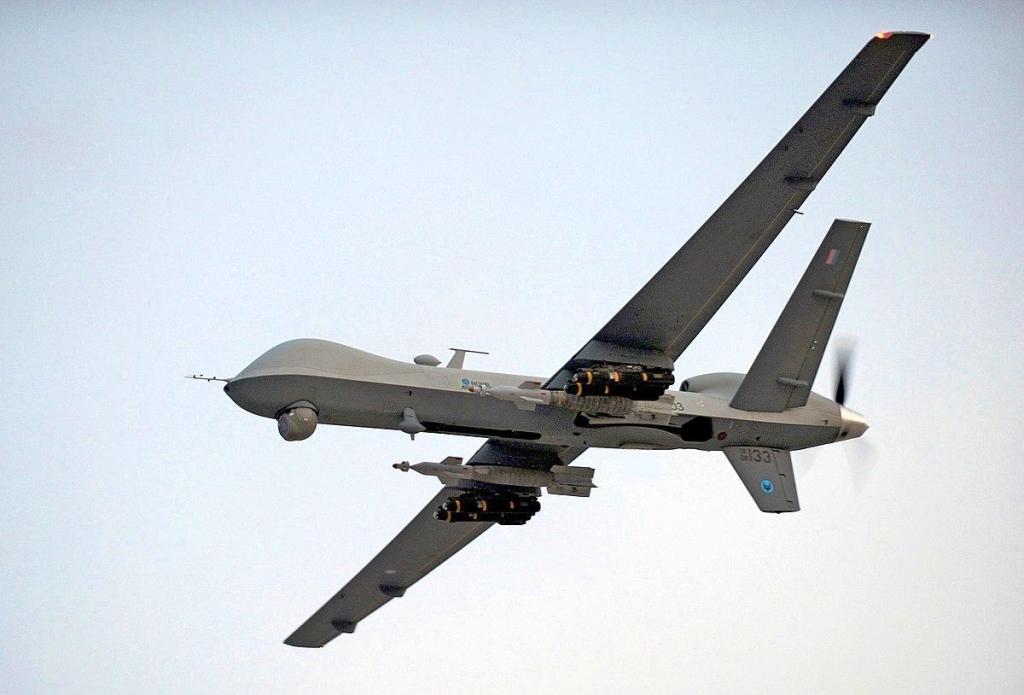
All UAVs are operated through control systems. Tactical control systems are compact and highly mobile, making them suitable for deployment on ships where space is limited and must be efficiently utilized. The most advanced drones can also be integrated into a Command and Control (C2) architecture. According to Professor Milan Vego in his book “Operational Warfare”, a C2 architecture is defined as “the primary means by which a theater commander sequences and synchronizes joint activities in peacetime and orchestrates the use of both military and non-military sources of power to accomplish assigned strategic objectives.” This allows UAVs to perform a wide range of missions. Therefore, Naval forces can use UAVs for :
- Reconnaissance and surveillance;
- Direct support for combat or training operations;
- Intelligence gathering;
- Tracking mobile targets.
UAVs as assets for maritime security
UAVs are an essential and flexible operational tool for maritime intelligence gathering. They are well-designed platforms for information collection. While drones will never replace human intelligence (HUMINT), they offer promising sources of SIGINT and IMINT. This allows intelligence production to occur with reduced risk of misinterpretation. Moreover, their integration into a C2 architecture streamlines the information processing steps, thereby optimizing the maritime intelligence cycle. This provides decision-makers with a clear and precise view in a timely manner, enabling informed decision-making and appropriate action.
The goal is to strengthen and accelerate the OODA loop. Commanders at sea are then better positioned to assess the desired effects of their actions. The OODA loop, developed by U.S. fighter pilot John Boyd, conceptualizes the decision-making process in response to a situation, with the aim of maintaining initiative. The loop consists of four phases: Observe, Orient, Decide, and Act. The objective is to influence the adversary’s behavior by making rapid and appropriate decisions. UAVs also enable the real-time information sharing with ship commanders and numerous intelligence users.
Commanders can utilize and disseminate collected data in near-real-time across any area of responsibility. Today, drone technologies enhance commanders’ situational awareness of the maritime domain by improving their ability to plan, sequence, synchronize, and orchestrate actions. Thus, a UAV can be linked to the operational reality, offering genuine decision-making autonomy to commanders at sea.
The added value of drones in maritime security operations is undeniable. They have become an indispensable tool for naval units worldwide, particularily in the Gulf of Guinea. Indeed, Navies in the region turns to drones for maritime surveillance. UAVs provide a relevant solution to certain capability gaps, such as persistence, autonomy, and coherence with onboard weapons systems. Traffic
filtering in a specific area can be performed in record time due to the considerable endurance of UAVs. Additionally, UAVs can carry Automatic Identification Systems (AIS), which have become one of the main tools for Maritime Domain Awareness (MDA) in the context of maritime security operations in the Yaoundé architecture for maritime security.
These tools help identify and classify unidentified radar targets, contributing to a more informed maritime operational picture, both in real-time and in depth, at maritime operational centers (MOCs). As a result, MDA capabilities are enhanced, and maritime law enforcement operations become more effective. Doing so, UAVs help address operational challenges with limited resources to achieve maximum effect. For example, pirates are operating increasingly farther from their bases, extending their areas of operation. Naval ships alone cannot cover such vast areas. The use of drones with several hours of endurance allows for the increase of monitored zones.
Conclusion
Maritime security requires significant resources from states. UAVs technology emerges as a reliable and flexible tool at the disposal of naval forces to ensure effective control of maritime spaces. Thanks to their information-gathering and processing capabilities, maritime intelligence becomes more precise, enabling commanders at sea, and often on land, to make the most appropriate decisions to counter maritime security threats.
About the Auhor : Lieutenant Commander (O-4) Djaiblond Dominique-Yohann KOUAKOU is a Navy Officer in the Navy of the Republic of Côte d’Ivoire. He has now accumulated 15 years of service and holds the position of Commander of a warship. He holds an Engineering Degree in Naval Operations from the Royal Naval Academy of Morocco. Additionally, he has a Master of Science in Maritime Affairs from the World Maritime University in Malmö, Sweden. He is passionate about the seas, particularly maritime security and safety aspects, as well as emerging technologies.


