


Introduction
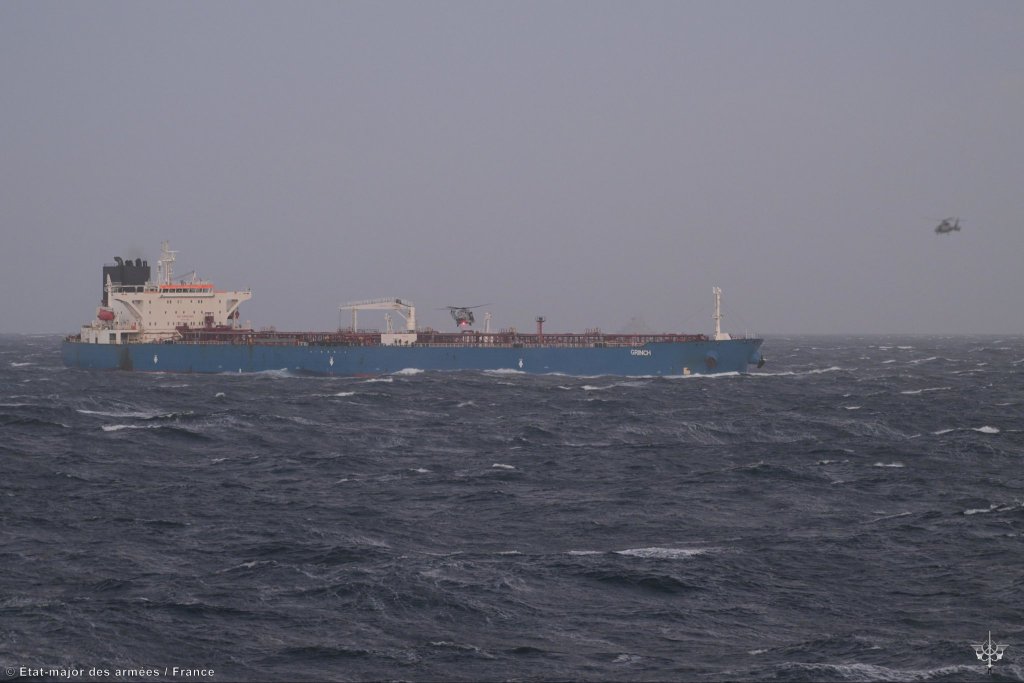
When the oil tanker Grinch was boarded in the Alboran Sea and diverted under escort to the Marseille-Fos terminal area in January 2026, the episode was presented not as a dramatic exception but as enforcement: a coastal state applying a sanctions-informed, safety-driven playbook to a vessel suspected of false flagging and shadow-fleet activity. According to Reuters’ account of the diversion to Marseille-Fos (23 January 2026), the tanker had departed Murmansk earlier that month, sailed under a Comoros flag, and was intercepted with allied support. French authorities subsequently placed the vessel at the disposal of the Marseille public prosecutor for checks related to maritime registration; The Brussels Times reported (25 January 2026) that exclusion zones were established around its anchorage in the Gulf of Fos.
The Grinch case has become a practical illustration of a wider trend that began in June 2024: the European Union’s shift from predominantly rules-based oil and price-cap restrictions towards ship-by-ship designations, combined with targeted measures against the companies and intermediaries that enable those ships to trade. That evolution matters for sanctions credibility and for maritime safety. The shadow fleet, typically older tankers operating with opaque ownership and fragmented compliance, tests how a major maritime jurisdiction uses port access, services bans, and law-of-the-sea tools to constrain a global trade that can reflag and reroute faster than legal regimes can be rewritten.
From price-cap compliance to vessel-by-vessel enforcement
The price cap model was designed to be economically constraining without a blanket prohibition on global oil flows. In the EU’s implementation, the central mechanism is the restriction of maritime transport and related services, most importantly insurance, when Russian crude or petroleum products are sold above the cap. The European Commission aggregates Coalition guidance and statements on its Price Cap Coalition guidance page, which centres on documentation, due diligence and risk-based compliance.
In practice, the cap’s leverage rests on the services ecosystem: marine insurance (including Protection and Indemnity cover), maritime finance, brokerage, technical management, classification, and port services. The price cap pushes cargoes into a documented compliance lane; the shadow fleet is the counter-move, an attempt to route trade through jurisdictions and service providers outside that lane.
Coalition guidance and industry notices have repeatedly pointed to risk indicators associated with sanctions evasion and unsafe operations: opaque or rapidly changing ownership; unexplained AIS (Automatic Identification System) gaps; irregular routing; and high-risk ship-to-ship (STS) transfers. The International Maritime Organization (IMO) has also framed “dark” or “shadow” fleets as a governance concern, urging action against illegal maritime operations; see IMO Resolution A.1192(33) (6 December 2023).
Against that backdrop, EU policy has increasingly sought to inject enforceable friction not only into the cargo transaction but into the vessel’s ability to operate: where it can call, who can insure it, and which counterparties can service it without incurring sanctions risk.
June 2024: the EU’s first vessel-specific listings
The EU’s 14th sanctions package, adopted on 24 June 2024, marked a qualitative shift. For the first time, the Council introduced measures targeting “specific vessels” contributing to Russia’s war effort, subjecting them to a port access ban and a ban on the provision of services. The Council stated that 27 vessels were listed in the initial tranche; see the Council’s press release on the 14th package (24 June 2024).
Operationally, a port access ban is more than denial of berth. It can complicate bunkering, repairs, crew changes and routine trading logistics. The accompanying services ban aims at the vessel’s commercial viability by obliging EU-linked insurers, banks, managers and technical providers to disengage.
This step also changed compliance logic. Under price-cap rules, operators assess a cargo’s price and documentation. Under vessel listings, the threshold question becomes whether a ship is designated, making it presumptively out of bounds for a wide range of EU-linked services regardless of the cargo paperwork.
France’s enforcement template: the Grinch and the earlier Boracay case
The Grinch diversion made visible how vessel-focused sanctions can translate into day-to-day maritime enforcement. In public accounts, the case turned on suspected false flagging and registration irregularities. The Guardian reported (22 January 2026) that President Emmanuel Macron described the tanker as “subject to international sanctions” and suspected of flying a false flag, with boarding and diversion conducted on the high seas with allied support. Reuters (23 January 2026) added that the ship was sailing under a Comoros flag and that the Marseille prosecutor’s office was handling the investigation.
Crucially, French authorities treated the episode as a judicial and regulatory process rather than a naval encounter for its own sake: escort to a controlled anchorage, safety and documentation checks, and the establishment of exclusion zones around the vessel’s position, as described by The Brussels Times (25 January 2026).
The operation also fits a pattern established months earlier. In late September 2025, France boarded the tanker Boracay (IMO 9332810) and required it to anchor off Saint-Nazaire; a subsequent sanctions-enforcement note by Duane Morris (6 October 2025) summarised reporting that the master and first officer were arrested in connection with failures to provide evidence of nationality or comply with orders.
A further development underlines how rapidly “identity management” has become part of the shadow-fleet operating model. In an investigation published on 15 January 2026, RFI (via ModernGhana) reported that the same IMO 9332810 had appeared in the Russian maritime register under the name Feniks and registered to Sochi, an apparent shift from repeated flag-hopping towards a more overt Russian-flag status. Public ship-tracking databases also link IMO 9332810 to a Russian flag under the names FENIKS or PHOENIX, underscoring how datasets may diverge even when the underlying hull identity is constant; see, for example, VesselFinder’s entry for IMO 9332810.
Taken together, the Boracay and Grinch episodes suggest that France is positioning itself as a leading coastal-state enforcer of sanctions-related maritime governance: using port access control, maritime policing powers, and the leverage of safe anchorage and inspection to raise the operational cost of shadow-fleet trading close to European shores.
Late 2024–early 2025: scale-up and anti-circumvention design
The ship-listing tool did not remain limited. By December 2024, the EU’s 15th package explicitly framed shadow-fleet designations as an anti-circumvention measure. The Council stated it was adding 52 vessels, bringing the total to 79 designated ships at that stage; see the Council’s 15th package press release (16 December 2024).
In February 2025, the 16th package added 74 vessels (raising the total to 153) and created new designation criteria to target individuals and entities owning or operating shadow-fleet vessels. It also introduced a transaction ban linked to certain non-EU financial institutions using Russia’s SPFS messaging system and expanded restrictions connected to ports and locks used for circumvention and by vessels practising “irregular and high-risk shipping practices”; see the Council’s 16th package press release (24 February 2025).
This is the structural point: the EU began treating the shadow fleet as a value chain, ships, owners, managers, finance, and physical nodes, rather than as a collection of anonymous hulls.
2025: the “three-layer” approach takes shape
European policy debate increasingly described a layered response: sectoral constraints on oil trade; vessel-specific sanctions (port and services bans); and individual listings targeting the people and entities enabling circumvention.
This framing appears explicitly in academic commentary. Francesca Finelli’s article, “The European Union against Russia’s shadow fleet: sanctions, circumvention and hybrid threats” (DPCE Online, 2025), argues that the EU response developed into a multi-layered approach combining sectoral prohibitions, vessel-specific restrictions, and individual designations, while also examining the legal and conceptual challenges of treating the shadow fleet as both a sanctions-evasion mechanism and a hybrid threat.
The European Parliament, for its part, urged stronger enforcement and broader listings. The text of the Parliament’s 14 November 2024 resolution is published in the Official Journal; see EUR-Lex publication of the Parliament resolution (C/2025/809). It calls for enhanced surveillance, stronger inspections, and action against vessels sailing without reliable insurance, reflecting the extent to which environmental and safety concerns have become interwoven with sanctions enforcement.
On the operational side, the 17th package in May 2025 was described by the Commission as targeting a record number of shadow-fleet vessels, adding a further 189 ships; see the Commission’s overview (20 May 2025). Media reporting around that tranche indicated a total list in the mid-hundreds; Euronews (24 May 2025) cited 342 vessels after successive rounds.
December 2025: towards industrial-scale listings
By late 2025, ship designations had become a standing instrument. On 18 December 2025, the Council announced restrictive measures against an additional 41 vessels, stating that this brought the total of designated vessels to “almost 600”, alongside listings of “shadow fleet enablers”. See the Council’s press release (18 December 2025).
At that scale, the policy aim is less about perfect interdiction and more about systemic deterrence. Large lists increase compliance friction for counterparties, charterers, brokers, terminals, bunker suppliers, insurers and banks, because screening becomes part of routine tanker due diligence, not a niche “Russia trade” issue.
The enablers: insurance, finance, flags, and management
Vessel listings are only as disruptive as the extent to which services and infrastructure can be denied.
Insurance and liability. A tanker operating without credible insurance is not merely a commercial risk; it is a coastal-state concern, particularly in confined waters and near sensitive coastlines. Parliament’s resolution explicitly links the shadow fleet to heightened environmental risk, reinforcing why authorities may be motivated to treat insurance verification and safety standards as enforcement levers. See the published text on EUR-Lex.
Finance and transaction channels. The EU has broadened its approach beyond EU institutions. The 16th package’s transaction ban linked to certain non-EU financial institutions using SPFS reflects a willingness to target facilitation mechanisms, not only cargoes or ships; see the Council’s 16th package summary.
Flags and governance. False flagging, rapid reflagging and frequent renaming are not just paperwork. They shape the enforceability of safety standards, responsibility for pollution, and the ability of counterparties to complete due diligence. The Grinch case, centred on doubts regarding flag regularity, shows how coastal states can use registration compliance as a gateway issue before a vessel can return to trade.
Law of the sea limits, and why coastal states matter
Calls to restrict shadow-fleet access not only to ports but also to EU waters raise legal constraints under the United Nations Convention on the Law of the Sea (UNCLOS), including freedom of navigation and the rules governing innocent passage. The practical enforcement space is therefore often found at the margins: port entry decisions, inspections, insurance verification, and the policing of safety zones around anchored vessels.
In December 2025, the EU signalled that the next phase of response would be framed explicitly within law-of-the-sea tools and critical infrastructure protection. A Council-circulated declaration referenced making full use of the law-of-the-sea framework against shadow-fleet threats and protecting undersea infrastructure; see the Council document publishing the declaration (15 December 2025).
Here the relevance of France’s actions becomes clearer. EU institutions can list vessels and define services bans, but coastal states operationalise the regime: they decide what enters ports, how inspections are conducted, and how maritime policing assets are deployed in approaches and anchorages. The Grinch’s anchorage under judicial control near Fos-sur-Mer is therefore best read as an enforcement signal as much as a single case file, an illustration of how sanctions design and maritime governance increasingly converge.
Conclusion
Since June 2024, the EU has moved from tightening price-cap compliance rules to building a vessel-centric blacklist and a growing enabler-focused strategy. The Grinch diversion, and the earlier Boracay detention, show how coastal states, particularly France, can turn EU designations and safety powers into tangible operational constraints. The trajectory suggests a longer contest between Russia’s adaptive sanctions-evasion tactics and Europe’s evolving combination of listings, surveillance, inspections and law-of-the-sea tools.


