


Since the start of the war in Ukraine, the Russian Shadow Fleet has been operating in the murky waters of clandestinity and illegality, circumventing the international sanctions facing the country.
This fleet, made up of old, obsolete oil tankers, operates outside international regulations and surveillance radars. For Russia, the aim is to circumvent the sanctions the country has been facing since the start of the war in Ukraine, in order to pursue its economic activities.
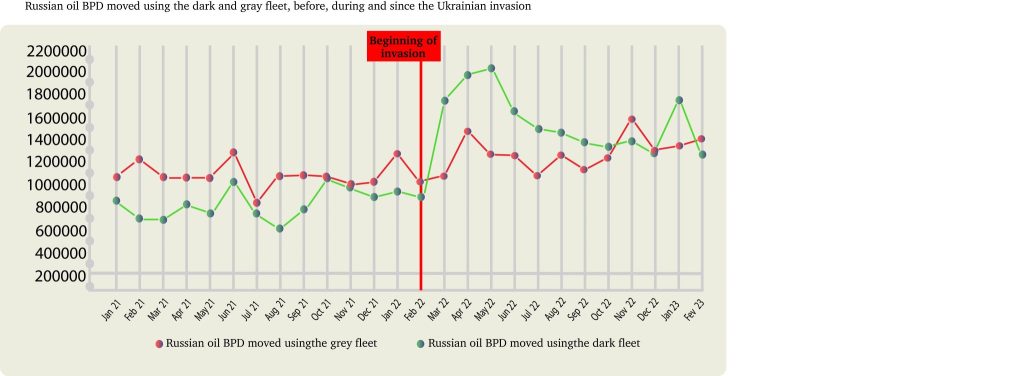
Since February 2022, Shadow Tanker Fleet activity has increased by over 50%, according to a recent analysis led by the Norwegian Coastal Administration. Comprising some 1,400 vessels of all sizes, from 30,000 to 300,000 deadweight tons, this fleet represents a considerable environmental hazard due to its old age. Since their employment in the context of the conflict, their lifespan has been extended by more than 6 years on average, from 8.3 years in 2020 to 14.6 years in 2023. For tankers operating in the Russian enclave of Kaliningrad, in the Baltic Sea, the service life of these vessels is even longer, with an average age of 29.3 years, compared with 15.4 years in 2020.
Over the past two years, these tankers have been making frequent trips. Their itineraries have also evolved. As the main enclaves have moved towards Asia, the Dark Fleet now includes a large number of vessels flying flags of convenience near the Cook Islands, Gabon, Cameroon and Vietnam.
Origines and Modus Operandi
While the term “Dark Fleet” is widely used to refer to the Russian Shadow Fleet, it historically refers to the fleet that emerged from the mid-1990s onwards, following the sanctions imposed on companies exporting crude oil from Iran and Venezuela.
The current Russian Shadow Fleet is, in fact, characterized by the name “Grey Fleet” and is used primarily to export crude oil, heavy fuel oil and refined products from the Russian ports of Primorsk, Ust-Luga, Murmansk, Novorossiysk and Koz’mino, mainly to India and China. It emerged in response to the international sanctions imposed on Russia, designed to restrict its commercial and oil activities. To circumvent these coercive measures, Russian economic and political players set up this clandestine fleet. Most often, Shadow Fleet vessels use tactics designed to make them go unnoticed by concealing their location or the origin of the crude oil transported from Russian ports. The crude can then be refined in India and other countries, or even re-exported to Western countries sanctioning the Kremlin.
According to a statement reported by AFP from Elina Ribakova, an economist at the Kyiv School of Economics (KSE), ” Over 70% of Russian oil transported by sea is thanks to the shadow fleet “.
Made up of obsolete vessels that are difficult to trace, the shadow fleet can sail undetected by modern surveillance systems. In addition, shadow fleet vessels are not covered by P&I insurance, which is specific to maritime transport and provides unlimited compensation for third-party damage.
Activities and implications
The activities of the Russian Phantom Fleet include the clandestine transport of oil and other goods, often in violation of international embargoes. These practices not only circumvent sanctions, but also fuel a parallel economic network that is opaque and difficult to control.
On February 23, the United States blacklisted 14 tankers used by Russia to enforce the price cap on crude oil sold by Moscow. For the most part, the sanctions announced in a US Treasury statement target Russia’s national shipping company Sovcomflot. The company has been given 45 days to unload its cargo, spread over the 14 vessels it owns.
Over the past few months, Gatik Ship Management, a hitherto unknown company, has spent almost $1.5 billion in a dozen months acquiring a fleet of old ships considered obsolete. These would carry exclusively Russian oil and products. “I’ve never seen anything like this, and I’ve been observing this sector for 25 years” said Mr. Bockmann.
According to a report from the Financial Times, Gatik is probably linked to Rosneft, the Russian oil giant. These allegations were confirmed by Mr. Bockmann, who indicated that four successor companies to Gatik had been registered in Turkey.
A danger to navigation
To go undetected, the Russian shadow fleet uses clandestine tactics, including “AIS gaps”, created by disabling the transponder of a ship’s automatic identification system, as well as ship-to-ship transfers in international waters unchecked, “re-flagging”, or changing a ship’s country of registration, and “complex ownership and management structures that change every month”, according to Michelle Wiese Bockmann.
Disappearing from radars, Shadow Fleet vessels often operate in remote or little-surveyed sea areas. The lack of adequate surveillance increases the risk of collisions with other vessels, particularly in areas of dense maritime traffic.
In addition, the obsolescence of these vessels can lead to mechanical failures and dangerous situations at sea. Failure to comply with maritime safety standards increases the risk of incidents such as oil spills, explosions or shipwrecks.
An ecological disaster
Due to the ageing of the fleet, shadow fleet vessels represent a considerable ecological threat, incurring potentially devastating ecological consequences for marine ecosystems. Because of their clandestine status and non-compliance with safety standards, these vessels are more likely to cause environmental incidents such as oil leaks and chemical spills. These incidents can have a serious impact on marine life, contaminating waters and affecting the health of marine species, including fish, birds and marine mammals. In addition, the areas affected by these incidents can suffer long-term ecological damage, compromising the biodiversity and productivity of marine ecosystems.
In May, the 27-year-old Gabon-registered tanker “Pablo” suffered a major explosion off the coast of Malaysia. According to Le Monde newspaper, the vessel had a history of transporting sanctioned crude oil from Iran, and had probably just delivered Russian oil to a Chinese port before the accident occurred. This incident is a textbook case of the Russian Shadow Fleet’s danger.
Conclusion
The growing presence of Russian shadow fleet vessels in maritime areas raises serious concerns about security and stability.
Operating undercover, this fleet of old tankers represents a threat to navigation and the environment. Its use, which has become significant since the start of the invasion of Ukraine, raises doubts about other illegal activities such as armaments transport, military intelligence and clandestine operations.
Furthermore, it became a weapon in itself, defying all compliance with international regulations.


