


Hardly any war has ever been fought exclusively with regular soldiers. Over the past decade, Russia’s state-sponsored irregular armed groups and private military/security companies (PMSCs) have expanded the repertoire of modern conflict, from ship protection and base security to expeditionary combat. This article traces that arc through the maritime born Moran Security Group and the Wagner Group’s expeditionary model, situating both within Russia’s legal grey zone and the wider international framework. It draws on authoritative law and reporting, including Article 47 of Additional Protocol I, the Montreux Document, and recent investigations into operations in Ukraine, Syria, Libya, the Central African Republic (CAR) and Mali.
From sea lanes to battlefields: Moran Security’s maritime origins and evolution
Anti-piracy decade
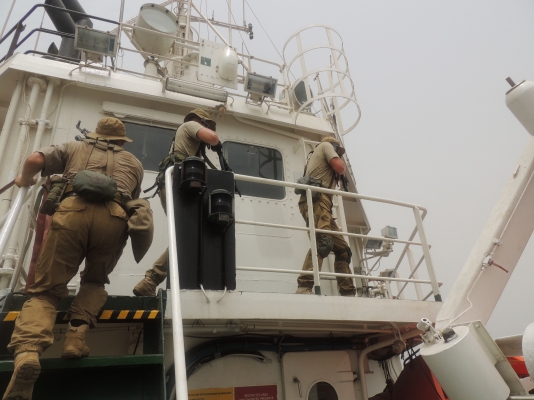
Founded around the late 1990s early 2000s, the Moran Security Group (MSG) positioned itself as a private maritime security company (PMSC) at the height of Somali piracy, advertising embarked armed guards, logistics and medical support for merchant shipping in the Red Sea Gulf of Aden Indian Ocean corridors. The firm describes its profile in corporate materials, emphasising veteran staffing and compliance language typical of the sector. This maritime niche emerged alongside International Maritime Organization (IMO) guidance that framed the limited and risk-assessed use of privately contracted armed security personnel (PCASP) as a complement not substitute to Best Management Practices against piracy, under IMO guidance and MSC circulars.
Beyond ship protection
As demand shifted beyond high risk transits, Russian companies diversified into fixed site security, convoy escort and training. Open-source studies map an ecosystem that includes RSB Group, Shchit (later associated with Redut), Patriot and Antiterror Orel alongside Moran, as documented by the Jamestown Foundation. Notably, two Moran executives, Vadim Gusev and Yevgeny Sidorov, registered the Hong Kong based Slavonic Corps in 2012 to deploy contractors to Syria—an episode that ended with their prosecution under Russia’s anti-mercenary statute, as covered in this analysis and a Moscow Times report. The link is also captured in reference works on the Corps’ origins and composition in the Slavonic Corps.
Commercial model vs. coercive leverage
Across theatres, Russian PMSCs have blended fee-for-service contracts with resource concessions and political patronage. In Syria, entities tied to Wagner, notably Evro Polis, secured agreements reportedly granting 25 % of oil and gas production from fields retaken or guarded by the group, according to this policy analysis. This “security for resources” pattern later appeared in CAR mining and timber deals, recorded in sanctions designations and a UN brief.

The Russian PMC ecosystem: firms, functions and chains of command
Who’s who
The roster most often cited includes Moran Security Group, RSB Group, Shchit/Redut, Patriot, Antiterror-Orel, the Slavonic Corps and Wagner. Profiles by research institutes and investigative outlets chronicle overlaps in personnel and backers, with ties to state entities and sanctioned oligarchic networks, including Jamestown analysis and New America.
Command linkages and deniability
Russian PMSCs operate in a legal twilight at home while acting as force multipliers abroad. The Kremlin’s preferred label “volunteers” has been used to frame irregulars since 2014–2015. In April 2023, the State Duma passed a bill extending combat veteran status to members of such volunteer formations participating in the war against Ukraine, confirmed in a Kremlin readout. Analysts note this sought to regularize benefits without openly legalizing PMCs, which remain prohibited as illegal armed formations under Russian law, as outlined in a PISM brief.
Capabilities portfolio
Russian companies advertise and field a spectrum of capabilities: ship and site protection, convoy escort, intelligence surveillance reconnaissance (ISR), training and mentoring, urban assault and information operations. In several theatres, Wagner and associated units operated with Russian Ministry of Defence support or deconfliction, including use of air support and artillery, while maintaining nominal deniability, as summarised in this Syria analysis and Jamestown reporting.
Law in the grey zone: mercenaries, PMCs and maritime security
Article 47 and the mercenary test
International humanitarian law (IHL) defines a mercenary in six cumulative criteria in Article 47 of Additional Protocol I and denies such persons combatant/POW status, according to the ICRC treaty database and the ICRC commentary. In practice, at least one criterion often fails, complicating prosecutions. Legal status turns on whether personnel are integrated into a party’s armed forces; otherwise, they risk criminal liability while lacking combatant protections.
The Montreux Document and gaps at sea
The Montreux Document—an intergovernmental instrument led by Switzerland and the ICRC—catalogues states’ obligations and good practices regarding PMSCs in armed conflict through an official overview and an ICRC publication. At sea, IMO circulars and flag-state guidance govern PCASP use, selection of PMSCs and rules on the use of force (RUF), anchoring risk assessments and BMP compliance under the IMO guidance, a representative flag-state circular, and Singapore MPA circulars.
Russia’s domestic legality puzzle
Russia’s Criminal Code outlaws organising illegal armed formations and mercenarism, a prohibition tested in 2014 when the Moscow City Court convicted Slavonic Corps leaders Gusev and Sidorov for their 2013 Syria venture, reported in this court coverage. Subsequent policy has relied on ad hoc arrangements: euphemisms such as “volunteers”, administrative benefits like veteran status, and opaque procurement without a comprehensive PMC law, examined in a legal analysis and a policy brief.

Case studies: expeditionary practice from Ukraine to Africa
Ukraine (2014–2025)
Russian irregulars have been present since 2014 in Luhansk and Donetsk, with Wagner later prominent in Soledar and the protracted battle for Bakhmut. Multiple investigations document the large-scale recruitment of prisoners into Wagner from mid-2022, with estimates in the tens of thousands. One reconstruction of Bakhmut’s toll used leaked Wagner rolls to identify at least 17 000 dead prisoners and to time the battle between July 2022 and June 2023, according to a Mediazona analysis. While claims of aggregate casualties vary and are often contested, all credible sources point to extreme attrition.
Syria (from 2015)
After its Donbas debut, Wagner embedded in Russia’s 2015 intervention in Syria, operating as shock troops and guarding energy infrastructure. Reporting and sanctions files indicate Evro Polis-brokered deals returning a quarter of production from retaken oil and gas fields to Wagner-linked interests, knitting battlefield roles to commercial profit, detailed in this policy analysis and the Evro Polis dossier.
Libya and the Central African Republic
In Libya, Wagner backed Khalifa Haftar with personnel and aviation, shaping front lines and logistics, according to field research and policy studies by the Rosa Luxemburg Stiftung. In CAR, UN and state briefings record severe constraints on MINUSCA’s freedom of movement and a pattern of abuses by Wagner-linked elements alongside government forces; sanctions have targeted Wagner’s commercial network there, detailed in a UN-linked brief, USUN remarks, and Reuters (30 May 2024).
Mali and the Sahel
Mali illustrates both the demand for rapid, brutal counterinsurgency and its costs. Human Rights Watch documented summary killings in Moura in late March 2022 during joint operations by Malian forces and apparent Wagner fighters. Subsequent investigations describe ongoing abuses including secret detentions and torture during Wagner’s tenure, with reporting in 2025 noting a transition from “Wagner” to Russia’s “Africa Corps” amid persistent allegations of atrocities, covered by Le Monde/Forbidden Stories, an AP investigation, and AP takeaways. The cumulative effect has been radicalization risks, degraded civilian protection and the shrinking of humanitarian space.

‘Siloarchy’ at work: oligarchs, ministries and the business of violence
Resource-security bargains
From Evro Polis in Syria to timber and mining ventures in CAR, Russian PMSCs embody a fusion of state aims and private rents. Sanctions narratives and investigative reporting document aviation leases, chemical imports for mining and front companies that tie security outcomes to extractive concessions, reflected in Reuters on sanctions and a UN-linked brief.
Effects on maritime and trade flows
Even when landlocked, these operations ripple into maritime commerce: port security deals, convoy risks along coastal corridors, and insurance exposure on West African and Red Sea routes. Flag state and IMO guidance on PCASP, selection standards and RUF remain central compliance anchors for shipowners navigating the thin line between necessary protection and escalation risk, under the IMO framework and Singapore MPA.
Strategic externalities
The presence of Russian PMSCs complicates peace operations, constrains monitoring and often correlates with spikes in abuses and civic-space restrictions, according to UN-related briefings and independent policy analysis, including USUN remarks and Security Council Report. For European and African policymakers, the challenge is to reinforce accountability mechanisms, support host-nation governance and protect maritime-trade resilience.
From Moran Security’s maritime beginnings to Wagner’s expeditionary campaigns, Russia’s “corporate warriors” exploit legal ambiguity to deliver coercive effects with political deniability. Their business model security for concessions, backed by state logistics and oligarchic finance reshapes local conflict economies and carries measurable externalities for shipping and trade. A pragmatic policy response combines rigorous PMSC standards (Montreux/IMO), targeted sanctions on enabling fronts, and support to investigations that document abuses while insulating maritime commerce from spillovers.


