Danish authorities are investigating whether three Russian-linked vessels served as launch platforms for the drone overflights that forced Copenhagen Airport to shut down on the night of September 22. The incident, described as the most serious attack yet on Denmark’s critical infrastructure, is fueling suspicions of Russian involvement.
Drones Disrupt Danish and Norwegian Airports
Three large drones, flashing their lights in a provocative manner, flew over Copenhagen Airport, prompting a four-hour shutdown. At nearly the same time, Oslo Airport in Norway was also closed for three hours after a drone was detected.
Prime Minister Mette Frederiksen condemned the raid as a deliberate attempt to create chaos, noting similarities with recent drone and airspace violations across Europe. In the same week, Russia violated Estonian airspace and launched at least 17 drones into Poland. Frederiksen stressed that Moscow’s role in the attack could not be ruled out.

The Danish Security & Intelligence Service (PET) and Copenhagen police said the drone flights were “professionally executed” and clearly intended as a provocation.
Russian-Linked Ships Under Investigation
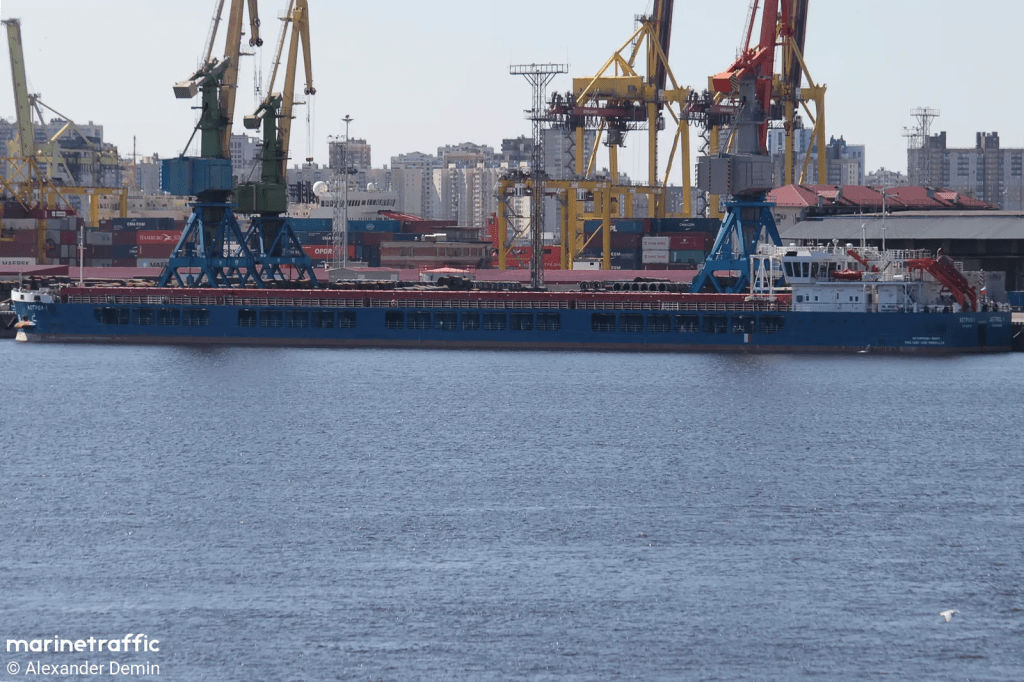
Authorities have focused on three vessels suspected of being involved, either as drone launch platforms or as decoys:
- Astrol 1 (IMO 9906544): A Russian-flagged coastal freighter observed making unusual movements north of the Oresund before the incident.
- Pushpa or Borocay (IMO 9332810): A tanker identified by Ukraine as part of Russia’s “shadow fleet.” It is fraudulently flagged under Malawi, a landlocked state with no valid registry. Equasis records show it has changed names three times in two years. Such fraudulent flags void insurance coverage.
- Oslo Carrier 3 (IMO 9366146): A freighter reportedly crewed by Russians.
Investigators note that while these ships were not directly near the airport during the drone activity—and Pushpa never entered the Oresund—their patterns raised suspicion.
If boarded, however, finding evidence may prove difficult. Drone launch equipment can be easily discarded, and operators could be swiftly transferred to other vessels. Iranian naval tactics, using small logistic ships such as Delvar and Hengam classes to launch drones, demonstrate the feasibility of such covert operations.
Previous Drone Incidents in Europe
This marks the second time in a month that European authorities have linked drones to suspicious maritime activity. On September 7, German police detained the Scanlark, a small cargo ship, in the Kiel Canal. Investigators suspect it launched a drone on August 26, controlled by a naval vessel for reconnaissance purposes. German police and prosecutors confirmed the case is tied to threats against critical maritime infrastructure.
The growing number of drone-related incidents in European waters highlights the challenge of attribution and the rising threat to airports and ports alike. As Denmark pursues its investigation, authorities across Europe remain alert to the maritime dimension of drone warfare.