


Since its democratization a few years ago, AI has been a fascinating tool for its many fields of application. What is the role of AI in maritime safety today?
Understanding AI in the maritime industry
Artificial intelligence was first introduced in the 1950s. In the maritime industry, it gradually established itself in the 2000s. This is due to technological advances in data processing and robotics. It relies on machine learning models and algorithms to improve risk management, decision-making and process automation. This is the latest breakthrough in maritime safety technology.
A retrospective. In the 1970s, the Global Maritime Distress and Safety System (GMDSS) was set up, allowing more reliable communication in case of trouble. Twenty years later, GPS revolutionized maritime navigation. In 2000, automatic identification systems (AIS) and radar were introduced to supervise ship monitoring. By 2010, drones, new sensors and AI had automated detection of risks at sea. This marks the beginning of a new era in maritime safety.
Key applications of AI in maritime safety
Analysis, prediction, optimization… AI’s capabilities are varied. Today, it has become a strategic asset in anticipating risks at sea and automating the monitoring of maritime areas, with the following scope of application.
• Navigation and collision avoidance systems
These modern systems enable precise detection of nearby ships in real time. AI is used to anticipate collision risks and make preventive recommendations. For example, SEA.AI’s vision technology is incorporated into the TZ Professional navigation software. It detects and classifies objects that are difficult to spot by conventional radar, such as people who have fallen overboard.
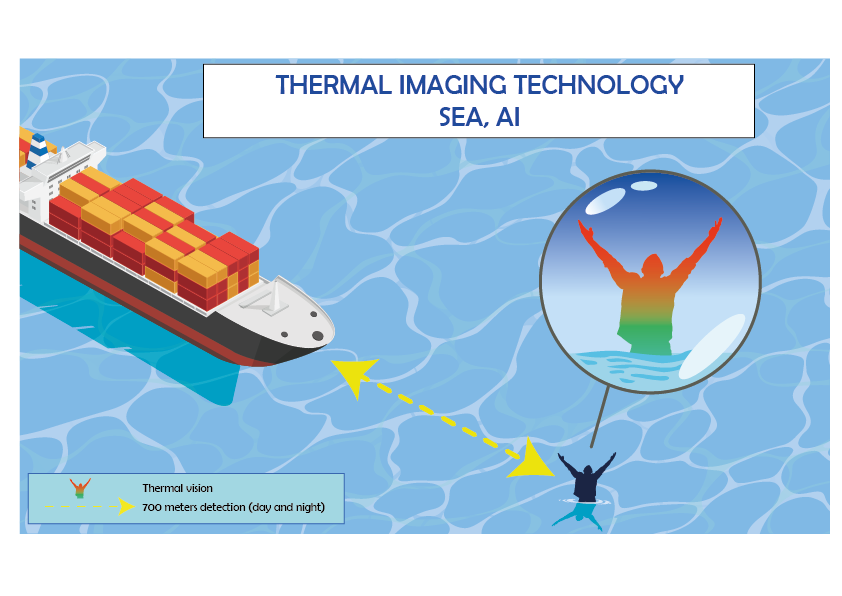
To do this, it uses thermal cameras with a range up to 700 meters. Following a test phase in La Rochelle, France, the technical director of electronics specialist Pochon SA describes this innovation as “ a revolutionary daytime detection solution, considerably enhancing safety during navigation.”
• Route optimization and weather prediction
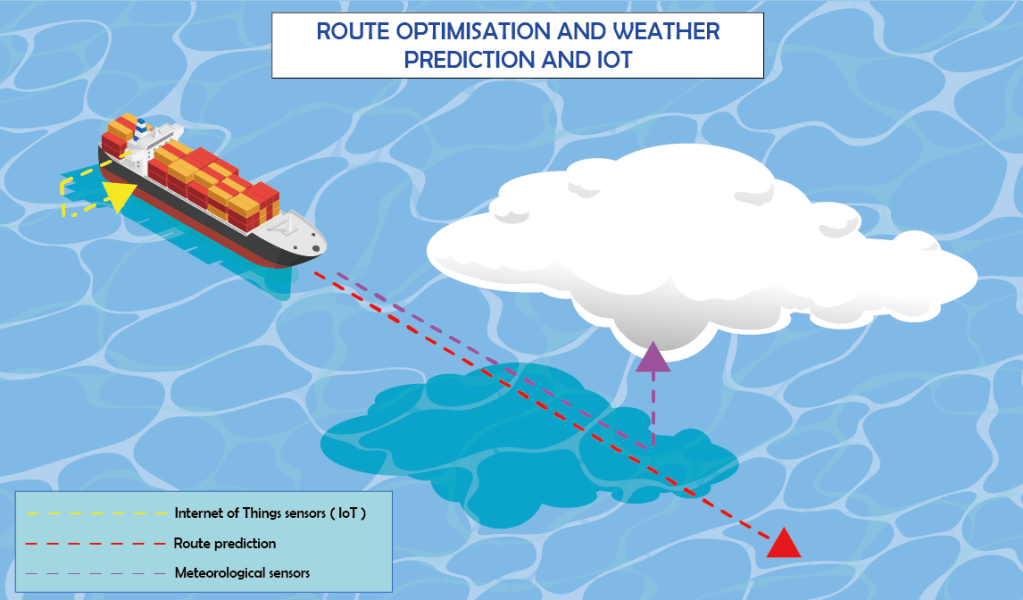
The massive data processing capacity of AI enables itineraries to be optimized by predicting weather conditions more accurately. This is having a positive impact, as it can reduce costs and adapt safer trajectories. The OneOcean and True North marine organizations, for instance, have advanced algorithmic solutions that also take into account greenhouse gas emissions.
• Real-time vessel health monitoring
As with its previously quoted uses, AI here adds predictive maintenance to vessel health. Typically, the system developed by Convergint aims to reduce potential breakdowns and accidents linked to it. This is made achievable by the use of IoT sensors.
• Automated decision-making processes
As a continuation of its analytical capabilities, AI can reinforce maritime safety by making decisions on its own, based on its findings. The question of how much control to attribute to AI is also being studied as part of the development and testing of autonomous ships, which are already transforming the industry.
All these spheres of application help to reduce human error, while increasing the initial capabilities of crews tenfold, for greater maritime safety.
AI-powered maritime security solutions
• Crimes prevention and response
Theft, smuggling and trafficking of all types… today, maritime crime is on the rise in all coastal countries. Detection, monitoring and analysis capabilities will play a decisive part in this fight.
• To counter piracy, drones will be able to count the number of people on board ships and analyze their behavior to prevent potential attacks.
• Against illegal fishing, commonplace in the Gulf of Guinea, maritime artificial intelligence will be able to recognize the identification number of a fishing vessel and determine whether it is fishing in a prohibited area, as well as checking its license.

In 2023, the Nigerian Navy announced the future use of AI to fight these two phenomena, which cost it millions every year. “ This is actually the future of military operations, so we need to make sure that Nigeria’s military keeps up with this technological advance […]” specified Vice Admiral Emmanuel Ogalla in June.
• Port security and cargo management
Far from being effective only on open seas, the use of AI is spreading to ports themselves. Covering both port security and cargo management, the digitization of ports has been underway for several years.Within these areas, algorithms for monitoring activities are now commonplace.Some countries, like Vietnam, are investing heavily in the development of AI systems focused on cargo management and port security.
• Cybersecurity for maritime systems
The dramatic increase in digital technologies in the maritime sector raises the question of the cybersecurity to be maintained. The role of artificial intelligence will be to protect systems against cyber-attacks. This is achieved by rapidly processing large quantities of data, and then identifying patterns of abnormal behavior or vulnerabilities within this organized data.
In Greenland, for instance, a Darktrace AI system was able to protect a maritime organization from a malware attack by detecting unusual connections on an infected device. This enabled the security team to react before any harm was done.
Challenges of AI integration in maritime industry
• Data quality, availability and processing
The integration of AI in the maritime industry raises multiple safety challenges. Starting with the question of data. Data on which AI relies to perform its task reliably. At the Ocean Economy conference in South Africa in May, the commercial director of Global Command and Control Technologies (GC2T) was already warning of these risks. The “quality” and “distortion” of data, the margin of error in its interpretation and “the possibility of cyber threats” are all crucial issues associated with maritime AI. In the face of all this, it is above all essential to maintain human expertise to oversee it all.
• Cybersecurity risks
The increasing importance of digital technology in maritime operations is introducing more and more potential cybersecurity risks. The merging of operational and information technologies, from which the very power of AI comes, opens up entry points for cybercriminals.
Worse – AI brings its own set of next-generation threats. AI tools can be used to automate attacks. These include the injection of false data to be processed by monitoring sensors, or the creation of false documents such as cargo manifests, certificates of origin or safety inspection reports.
• Ethical considerations and privacy concerns
Ethical considerations and privacy concerns deserve particular attention when it comes to data collection and monitoring. Since AI systems are built using data gathering from satellite sensors, this can lead to excessive monitoring, including unlawful intrusion into the private and professional lives of those operating in these areas. In the event of a hack, cybercriminals could also gain access to the data collected, compromising not only privacy but also the security of maritime operations. The environmental organization OceanMind uses AI to monitor the risks of illegal fishing around Pitcairn Islands. While the impact of the initiative is encouraging, it raises concerns about the excessive monitoring of local fishermen.
The question of system autonomy is also being discussed. Projects are emerging all over the world, as in the case of the Mayflower. This project of autonomous ship intends to be 100% autonomous. So, who is responsible in the event of an incident? What are the ethics behind decision-making?
This dimension complicates and slows down the creation of standards around the various applications of AI in the maritime industry. Standards that are nonetheless essential to the proper deployment of AI. ” By harnessing the power of AI, the maritime industry can move towards a safer, more sustainable and more efficient future. However, it is crucial to address the challenges associated with AI implementation to ensure it aligns with international standards and human rights principles. ” Affirms Jacobus Valentine, of GC2T.
Preparing for an AI-driven maritime future
In preparing the maritime industry to embrace these advancements, a number of challenges still need to be addressed.
• AI in maritime law enforcement and border control
The first of these is the question of international law. There is yet no established international legal framework, as the use of AI in this industry is still in its emergence phase. However, standards relating to maritime safety and risk management are indirectly helping to establish this framework. These include the 1974 International Convention for the Safety of Life at Sea (SOLAS), the 1982 United Nations Convention on the Law of the Sea (UNCLOS) on maritime space utilization and pollution liability, the 2004 International Safety Management Code (ISPS), the 2011 European Parliament Regulation 1207/2011 on maritime surveillance, and the 2022 European Regulation on cybersecurity of maritime infrastructures.
On its side, the IMO is also working on the issue: IMO Resolution A.1047 (27) on the management of autonomous systems, the IMO Maritime Safety Manual on Standards of Practice and its guidelines on the regulation of autonomous vessels in 2018. While the IMO has not yet established clear guidelines on AI, it is expressing growing interest on the topic. Since 2021, its working group, focused on MASS, has been making progress on the subject. Issues relating to safety, liability and system validation remain complex and require further regulation.
The International Organization for Standardization (ISO), too, is already developing standards on the matter. ISO/IEC 2382, for example, defines the fundamental concepts of AI. ISO 19030 begins to integrate intelligent tools for failure prediction. ISO/IEC 27001 deals with embedded systems, including automated systems.
Overall, specific regulations for AI in the maritime industry are likely to be under development for several years yet. Although some initiatives exist, it is not yet possible to generalize them.
• Investments, infrastructure and training requirements for AI adoption
As revolutionary as it is, AI technology is particularly expensive. To guarantee a sustainable future for its use, it is essential to be able to support it by investing in robust digital infrastructures, including secure networks and intelligent, scalable control centers.
New technologies also mean new skills for industry professionals, such as programming and management of these technologies and systems, as well as a general awareness of the risks associated with data, its interpretation and use.
• Environmental monitoring and protection initiatives
AI technologies applied to the maritime safety could enable early detection of environmental pollution, preserve ecosystems and even predict ecological incidents.
For example, we now know that global maritime traffic greatly disturbs the marine fauna affected by its trajectories. It will be possible to avoid populated ecosystems or migrating marine animals. This will be achieved by detection combined with trajectory adjustment. In environmental terms, AI can only be beneficial. However, in the future, if the players with this technology decide to focus on the capitalist dimension, they may prefer to stay on their usual optimized trajectory to save time, fuel and money.
Summary of AI’s impact on maritime safety and security
In the maritime industry, AI has been evolving since the 2000s. With its unrivalled monitoring and risk-management capabilities, it enables early detection of threats, be they environmental, criminal or logistical. Its future use has yet to be determined by the laborious implementation of international regulations, a strengthening of cybersecurity and an adaptation of the maritime world. In an extremely competitive environment, some questions can be raised. Typically, what role will sustainable navigation play in the industry by the time this technology is standardized?


