


Earlier this year, Norway took a controversial move by deciding to open vast areas of its Arctic seabed for deep-sea mining activities. Despite an international outcry, the government has initiated a process on the first licensing round. This positions Norway as one of the first countries to exploit seabed minerals in such fragile and largely uncharted waters. While clearly controversial, is it in line with international law?
Proposed by the Norwegian government, on January 9, 2024, the Parliament, Stortinget, decided to open 281,200 sq. km of Arctic seabed to deep-sea mining – amounting to the size of Italy. This came despite strong criticism from Norway’s Environmental Agency and Geological Survey, along with NGOs, financial institutions, scientists and fishery organisations. They warned that deep-sea mining would threaten marine biodiversity, fish populations, and climate stability, as the Arctic contains ecologically vital and vulnerable ecosystems. Reacting to the controversial decision, the European Parliament passed a critical resolution urging Norway to apply the precautionary principle – meaning deep-sea mining should not be permitted until environmental risks and the long-term impact of the industry fully understood – and support an international moratorium on the industry, a position that was later shared by the Council of the EU. So far, at least 32 countries worldwide have asked for a pause, moratorium or ban on mineral extraction of the seabed, including Norway’s neighbours Finland, Sweden and the Kingdom of Denmark (including Greenland and the Faroe islands).
Norway’s Ministry of Energy initiated its first exploitation licensing round on 26 June, covering 106,000 square kilometres, with plans to issue licenses to companies by mid-2025. This area makes up 38% of the total area that has been opened for this activity. The Norwegian government recently concluded a three-month public consultation on the licensing proposal.
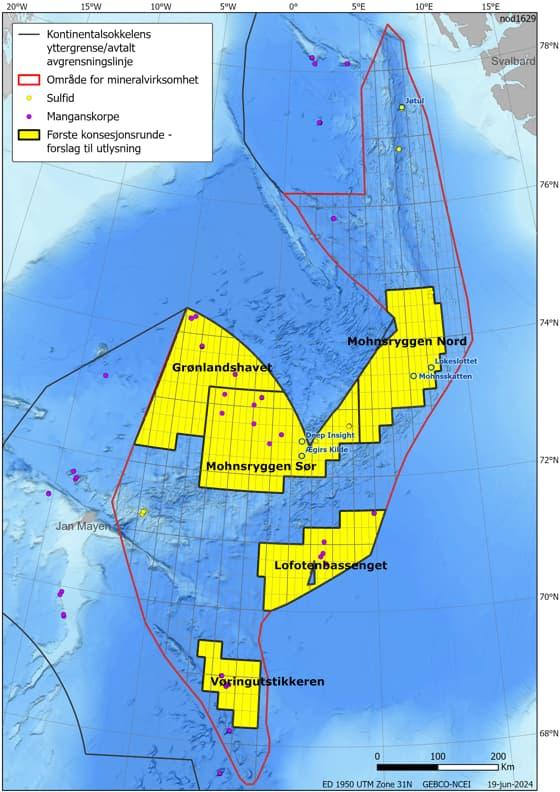
The licenses, which the government wants to award in 2026, will give companies exclusive rights to explore but not yet extract resources. Each company must submit plan of extraction and conduct a project-specific impact assessment for approval before exploitation can begin. The Norwegian parliament has to approve the first plan of extraction. Only companies registered in Norway are eligible, including major Norwegian firms Loke Marine Minerals, Green Minerals, and Adepth Minerals, with Loke and Green Minerals also seeking licenses in international waters under the International Seabed Authority (ISA) – the UN-affiliated body in charge of managing the seabed on international waters.
Following the initiation of the licensing process, the Norway chapter of WWF announced they have filed a lawsuit against the Norwegian government on the grounds that the strategic environmental impact assessment (SEA) forming the basis of the government’s decision to open an area for deep sea mining, does not meet the minimum legal requirements under the Seabed Minerals Act in Norwegian law.
The precautionary principle and the Espoo Convention
The precautionary principle – a cornerstone of international environmental law – emphasises the need to take preventive action when an activity poses potential risks to the environment, even if scientific certainty about those risks is lacking. The principle is particularly relevant in situations involving complex ecosystems or activities with far-reaching impacts, where uncertainty is high. In these situations, states have the obligation to err on the side of caution, ensuring that potential harm is mitigated before irreversible damage occurs.
Norway is a signatory to the Espoo Convention, which puts the precautionary principle into action by providing a clear framework. The convention requires parties to carry out environmental impact assessments (EIA) and engage in cross-border consultations for projects that could cause significant environmental harm beyond their borders. Building on this, the SEA Protocol outlines specific obligations for states to integrate environmental considerations into project planning. This ensures that potential risks are identified and addressed early in the planning stages. However, these obligations primarily come into effect once activities, such as resource extraction, begin following a formal opening decision.
Norway, as a signatory, is obligated to adhere to the Espoo convention regime.
The UN Law of the Sea
Looking specifically at state obligations on marine activities, article 206 of the UN Convention on the Law of the Sea (UNCLOS) concern EIAs for activities under states’ own jurisdiction that may significantly harm the marine environment, including areas beyond national jurisdiction. This obligation, reinforced by the advisory opinion of the Tribunal of the law of the Sea (ITLOS) in 2011, applies broadly to ensure states assess and communicate potential environmental risks.
Under Article 208, UNCLOS obligates states to adopt laws preventing pollution from seabed activities and align them with international standards. To date, the ISA has not adopted rules, regulations and standards (the so-called Mining Code) on deep-sea exploitation. If a forthcoming Mining Code will become stricter than any national regulations or a temporary moratorium from the ISA, this would directly influence Norway’s obligations.
While UNCLOS is a framework convention with general provisions, it must be interpreted alongside other international obligations such as the Espoo convention.
The Norwegian EIA
The Norwegian Seabed Minerals Act section 2-2 demands that a SEA shall be conducted, containing the impacts an opening decision could have on the environment, other industries, as well as economic and social impacts of the decision. The SEA shall shed light on all the different interests in the area to create a basis for the decision of whether to, and under which conditions, an area can be opened for deep-sea mining activities.
The deep-sea mining SEA was released on public consultation in 2021 and is based on nine basis reports. Despite the knowledge gaps being clearly outlined in the basis reports, the SEA concluded that the environmental impacts of the exploration activities to be minimal, and that the impacts of exploitation to be largely unknown but likely mitigatable.
The SEA received strong criticism from several stakeholders, most notably the Norwegian Environment Agency. It points out that although the basis reports recognise the knowledge gaps, the conclusions to go ahead with opening the area for deep-sea mining would be premature. Citing the lack of knowledge, the agency concluded that the SEA “does not provide a legal or scientific basis for an opening decision […]”.
This is nothing ground-breaking looking at the current scientific understanding of the deep sea. Deep-sea mining is widely recognised by scientists as a major threat to marine ecosystems. This activity involves grinding habitats with heavy machinery, releasing toxic sediment plumes that smother marine life far beyond the mining areas, and generating noise and light pollution harmful to vulnerable organisms. The impacts include the irreversible destruction of fragile habitats, extinction of species – both known and undiscovered – and disruptions to fish populations and broader ecosystems. Deep-sea mining also jeopardises the ocean’s ability to store carbon, a critical process for climate stability.
For the Arctic context, the Norwegian Institute of Marine Research has highlighted the substantial knowledge gaps that still exist about deep-sea life, emphasising the unpredictability of mining impacts on these unexplored ecosystems. They “cannot see that the present [SEA] satisfies what can be expected of Norway as a port nation that emphasises knowledge-based sustainable management.”
No new EIA will be conducted
The Norwegian government has vowed to use a stepwise approach to deep-sea mining to abide by the precautionary principle. According to them, exploration activities will cover the existing knowledge gaps and that no exploitation will take place if environmentally harmful.
There are misconceptions about the opening decision merely allowing for companies to conduct exploration activities after being awarded a license. However, the January decision to open up some areas clearly states that it is both an opening of exploration and exploitation activities. More specifically, the government now has the right to award exploitation licenses to companies that want to explore blocks of areas within the opened area that has been announced for the licensing round. The licenced companies can then submit a plan of work to start exploiting the seabed mineral resources, with a project-specific EIA attached. Although the first plan must be approved by parliament, this does not require a new opening decision or a fresh SEA for the entire area being opened. As a result, new findings on regional impacts on fisheries, cumulative effects from projects, and broader environmental concerns are not reassessed in a holistic manner. A correct stepwise approach requires utilising area-based management tools based on continuously gained knowledge and experience. Opening large parts of the Arctic for exploration and extraction with the current lack of knowledge contradicts this approach.
Conclusion
It is easy to understand Norway’s decision to open its Arctic waters to deep-sea mining raises serious concerns. Despite overwhelming scientific consensus warning of the catastrophic risks to biodiversity, fisheries, and global climate stability, the Norwegian government has chosen to prioritise industrial exploitation over the protection of one of the world’s most fragile and vital ecosystems.
By moving forward with the licensing process for deep-sea mining without meeting the necessary environmental safeguards such as a proper SEA and stepwise approach, Norway is disregarding the precautionary principle enshrined in international law, most notably the Espoo convention and UNCLOS. Opening blocks of 38 % in its effort to expediate the process already in 2026 is a shockingly large area for the first round of licenses considering the current uncertainties. Worryingly, the Norwegian Minister for Energy Terje Aasland has indicated that seabed exploitation activities may start as soon as 2030, clearly disregarding scientists’ calls for time to gather sufficient knowledge about the deep sea.
WWF Norway’s legal action will serve as a critical test of whether Norway can be held accountable for its obligations under domestic law, which draw on international treaties. The Oslo court is due to announce its ruling in early 2025, which might overturn the government’s timeline. It is to be seen if legal cases will be opened on the basis of international law.
With increasing calls for a moratorium from NGOs, the scientific community, and other nations, including most recently its Nordic neighbours, Norway may find its reputation tarnished in the eyes of those who view it as a critical player in the fight for ocean protection and climate stability. The long-term damage to its international standing, as one of the leaders in the High-Level Panel for a Sustainable Ocean Economy, could diminish its ability to influence global ocean governance moving forward, especially as momentum builds for stronger protection of the high seas.
– Simon Holmström, Deep-Sea Mining Officer


