


Powerless traditional fishermen in West Africa have watched their fish stocks dwindle over the years, mainly due to overfishing or illegal fishing by other countries. The area is a victim of the plundering of natural resources and is threatened by large fishing industries such as Russia. The NGOs Greenpeace warns of “economic and environmental crises”.
The importance of fishing in Africa
Thanks to its protein content, fish is an important source of nutrition in rural areas. Fish represents between 22% and 50% of the main proteins in the daily diet. Pelagic fishing is the main fishing technique in West Africa, and is also the main activity resource in the artisanal transformation industry. In Senegal, 600,000 people earn their living from this industry, about 1/6 of the Senegalese working population. In Ghana, 80% of the fishing community is artisanal and provides employment to 3 million people. These figures show how important the fishing industry is for the African economy and for the health of the population. In fact, 200 million people in Africa consume fish. It is not limited to coastal areas, countries such as Burkina Faso or Mali are dependent on coastal countries.
In 2022, because of the overfishing by the industrials, the stock of the sardinella, the principal fish; dropped of 80%.
Violation of bilateral fishing agreements in the EEZ
Fishing is legally managed by the coastal countries, following the Montego Bay Treaty. Several countries such as Mauritania, Senegal, Morocco and Guinea have signed bilateral agreements to monitor fishing in their EEZ. Russia is one of the countries using this kind agreement with West African countries, not always for the best.
In the past, Russia has come under fire for outpassing its rights. Relations with Morocco soured in 2020 when Morocco was reluctant to extend the previous agreement because Russia didn’t respect the fishing quota. Off the coast of Senegal in 2012, the Russian boat Olev Naydenov was spotted fishing illegally and arrested. GAIPES, an association of Senegalese fishermen, accused the Russian boat of “polluting the Senegalese fishing industry“, but also of committing an “economic and environmental crime” They aslo added that the presence of the Russian trawler was a “catastrophe“.
In 2023, the same thing happened again when a Russian fishing boat came to fish in the Senegalese EEZ without a licence. Greenpeace reports a “kleptocratisation” of fishery resources. In a report, the NGO shows how no fishing agreement has been signed between Senegal and Russia, and yet Russian boats are still fishing in the area with impunity. The UN’s trade and development agency warned in 2016 about overfishing in Africa. For the record, Russia has already been accused of overfishing in the Baltic, Arctic and Black Seas.
“The Great African Expedition”: a tool to expand Russian fishing activities in Africa
It is very unclear how Russia manages to fish with an industrial vessel in the EEZ of some African countries without sanctions; but Russia may have found a way to make a presence of influence in West African waters and even beyond. Russia and 18 other countries have entered into an agreement called “The Great African Expedition“.
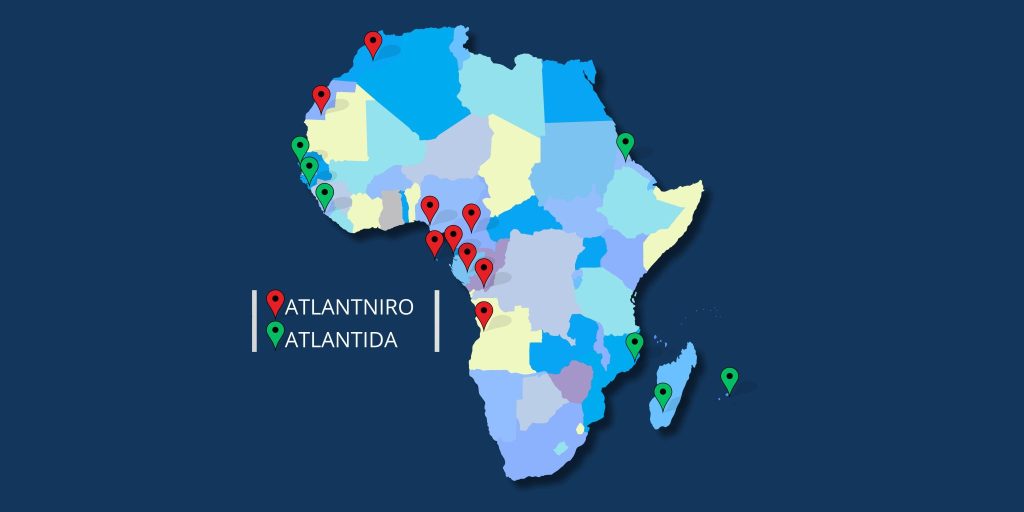
The first ship, the Atlantniro, will cover the coasts of countries such as Mauritania, Nigeria, Morocco, Cameroon, Sao Tome and Principe, Gabon, the Republic of Congo, Equatorial Guinea and Angola. The second ship, Atlantida, will focus on the waters of Guinea-Bissau, Senegal, Mozambique, Sierra Leone, Madagascar, Mauritius and Eritrea. The aim of the expedition is to provide “scientific data on Africa’s biological resources”, according to the head of the Federal Agency for Fisheries, Ilya Shestakov.
A controversial method, because it is also a way for Russia to find “new opportunities in the fishing industry” and to “strengthen Russia’s geopolitical position in Africa“. The Deputy Prime Minister added: “Of course, we are counting on reciprocal steps – the possibility of admission to their economic zones for fishing”.
In 2023, Russia refuses to sign a historic treaty proposed by the UN to protect the ecosystem of the high seas. Russia is not the only accused of overexplotation in Africa, China also has a very contreversial influence in these contries.


