


No storm or rain, no high waves or bad weather, the Titanic sank on a calm night between 14 and 15 April 1913. It hit an iceberg in the Labrador Current near Terre-Neuve. Since that night, many questions have been raised about the event, but one is still debated: who could have saved the Titanic?
One last time, at 2:18 a.m., the light of the Titanic flashes before she goes out. Two minutes later, the largest ship of its time was submerged.
Popularised by the notorious film of the same name, the reasons behind the Titanic’s sinking have been much studied and researched by historians, scientists or enthusiasts. But the RMS Titanic didn’t sink ignored. The Baltic, the Carpathia, the Frankfurt and the Brima were informed, either by radio or thanks to the Titanic’s distress signal. Out of all these ships, the SS Californian, a British Leyland Line steamship, is still suspected of ignoring the Titanic’s call for help, writing a century of backlash against Captain Stanley Lord. After the tragedy, two inquiries were opened, a British one and an American one.
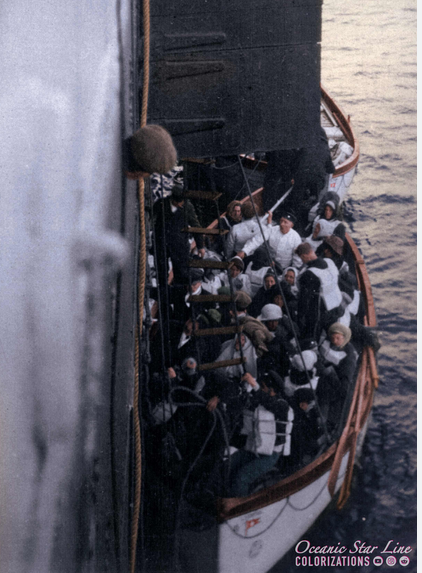
Photographer J.W. Parker.
SS CALIFORNIAN CONTREVERSY
The lack of response from the Californian was based on three arguments: the wireless communication that had been switched off by the SS Californian, the failure to respond to flashing lights, and the actual distance between the ships.
Only 20 nautical miles from the tragic event, closer than the Carpathia, which rescued the survivors at dawn, the SS Californian was stopped by the ice field. What happened next is subject to many speculation. At 11:40pm, the Californian’s radio operator, Cyril Evans, went to bed, having warned ships in the area that they were “surrounded by ice”. The captain of SS Californian, Stanley Lord, decided to shut down her engine for the night.
The icebergs that struck the Titanic came from the same ice field. Unfortunately, Jack Phillips, the Titanic’s wireless operator, did not relay this warning to the bridge, as he was too busy transmitting passenger’s messages on a loud frequency.
When Evans went to sleep and switched off his Marconi wireless set, direct and clear communication between the two ships ended, causing much confusion. It is worth noting that wireless communication was not popular at the time, which may explain why Evans was not awakened until 4am, much too late.
However, telegraphic communication was not the only way of exchanging information. The Titanic and SS Californian could see each other from a distance, as the testimony of both ships shows. When several rockets were fired, eight in all, seen by officers on the Californian, and morse lantern signals were used by the Titanic, none of these were interpreted as distress signals, but as company signals (To follow the compagny’s intinary route).

Confusion and mistakes
The British Inquiry asked Captain Lord about this. Lord was informed about the flares by the third officer, Herbert Stone. He asked about two characteristics: the colour and the frequency. If the colour, white, was indeed the right one for a distress signal, the frequencies were approximately five minutes apart. However, the correct procedure for firing distress signals is one minute or less of intervals, not five. Following the norms, Lord decided to ignore them.
As for the Morse signals, the crew of the SS Californian admitted to the British inquiry that they had seen the light flashing, but did not interpret it as a way of communicating. Yet still, the captain and crew of the Californian could see the lights of the Titanic and described it as looking “queer” and “big side out of the water”. Eventually, when Titanic’s lights disapeared, Captain Lord and his crew assumed it just had steamed away while she actually sank.
Tim Mailtin, a historian, theorised why Lord Stanley and his crew couldn’t interpret the lights correctly. When cold and hot water mix, it can create a thermal inversion, creating a distorted water mirage. It is known from survivor testimony that the temperature dropped suddenly that night.
Because of all this confusion and misunderstanding, the Captain Stanley only reacted at 4am, when he decided to wake up the radio operator, Cyril Evans.
Captain Stanley Lord was questioned by the British Board of Trade Wreck Commission and by the US Senate. He testified that he tried to make contact before midnight using the lamp signals, which means before the sinking, but it was innefective. However, most experts agree that wireless communication would have been a better idea.
Could it arrived on time
Let’s admit that the SS Californian took all the indications correctly, could she arrive in time to save the lives of the passengers? Scientists have estimated that a person who has fallen into the water, at a temperature of -2°C, could only survive 20 minutes before dying.
However, as the SS Californian had stopped its engines and was surrounded by ice, it’s not certain that it could have arrived on time. In addition, even if Cyril Evans had heard the Titanic’s distress signals, he would have heard the wrong position of the sinking, and the Californian would have been heading in the wrong direction. Initially, on the night of the sinking, Titanic transmitted the wrong position (41° 46′ N, 50° 14′ W), when in fact it was (41° 43)’, three miles south of the New York track.
THE SAMSON : “mystery ship”
But was the SS Californian the ship the Titanic survivors saw that night? Or is it another ship? A third ship could be involved; some believe it’s the Samson, a Norwegian sealing ship.
The defenders of Captain Lord’s innocence have used this theory to argue their case, based on the testimony of one of the Samson’s crew. Probably looking for a brief moment in the spotlight, officer Hendrik Bergethon Naess, a Samson’s crew member, testified in a Norwegian newspaper. He claimed to have observed the Titanic’s rockets in distress but left the area because they were illegally hunting seals. In addition, the Samson was not equipped with a radio transmitter or receiver.
This latter theory has been heavily criticised by historians. Some inconsistencies have been pointed out by Leslie Reade; firstly, the Samson was returning from a seal hunt in Cap Hatteras, which wasn’t known to be a seal hunting area. Secondly, the Samson’s documented registration at that time in April 1912, made it impossible for the ship to have been near the sinking location of the Titanic, as the Samson’s was located in Isafjordu shortly after the event.
For all these reasons, the “mysterious ship” cannot be the Samson due to the lack of evidence. It seems that it can only be the SS Californian, which was close enough to the Titanic to be seen by her passengers.
CARPATHIA RUSHING

In the midst of this disaster, the Carpathia stood out as the ship that saved the Titanic. Alerted by the Titanic’s distress signals, Harold Cottam, the Carpathia’s radio operator, communicated with the Titanic. Unlike Cyril Evans, Cottam heard the « CQD » and immediately relayed the message to his captain.
Despite being 58 miles away from the incident, Arthur Rostrum, the Carpathia’s captain, decided to make a half-turn towards Titanic. By this time, everything the Carpathia could have done had been done. The Chief Engineer ordered every stroker and crew to be in position, heat and hot water were turned off to facilitate the production of steam, and lifeboats were prepared. The urgency of the situation was taken seriously by the captain.
Two hours later, at 4 a.m., the Carpathia headed for the sinking site and fired rockets to reasured the survivors.
Eventually 705 survivors were rescued and Arthur Rostron was treated as a hero, receiving the Congressional Gold Medal, the Congressional Medal of Thanks, the American Cross of Honour and a trophy offered by the survivors he saved.
After a sad series of mistakes, confusion and lack of response, it is hard to imagine that any ship in the area could have saved the Titanic from disaster. As far as the SS Californian is mentioned, it is uncertain whether the conditions, mainly climatic and technical, would have allowed a rescue. As for the other ships in the area, they were too far away or too slow to arrive in time. What will probably remain from this event are the communication problems and the need to harmonise international safety standards at sea, in spe for wireless communication. Shortly after the tragedy, in 1914, the first Convention for the Safety of Life at Sea (SOLAS) was issued.


