


Piracy has been an issue that has affected maritime navigation in recent centuries. Merchant ships are frequently attacked by criminals who endanger safety of human life at sea for economic purposes. The above, in addition to being a great risk to the lives of seafarers, hinders maritime trade; that is why the international community has joined forces to combat this scourge in strategic places, such as the Horn of Africa and the Gulf of Guinea.
In recent years, criminal acts against merchant, fishing and recreational ships have increased in the Venezuelan aquatic space, and it is clearly a cause of concern for the Venezuelan maritime sector. That is why in this article the legal definition of the crime of piracy and its incidence in Venezuelan territory will be briefly analyzed.
What can be considered maritime piracy?
To get into the matter, it is pertinent to briefly explain what the crime of piracy consists of. In accordance with article 101 of the United Nations Convention on the Law of the Sea (hereinafter “UNCLOS”) and article 15 of the 1958 Geneva Convention on the High Seas, piracy is defined as any act of violence, detention or depredation against a ship on the high seas, or against persons on that ship, committed from another ship, and such depredation must be due to personal or economic reasons. If an attack against a ship is motivated by other types of purposes, for example, political ones, then we cannot speak of piracy but of other types of crimes, such as terrorism.
Piracy is a crime subject to universal jurisdiction, since it is considered a crime against all humanity. And what does universal jurisdiction consist of? Those who commit acts of piracy can be captured by a warship of any State, be prosecuted and tried by the courts of the State that captured the perpetrators. Now, for an attack against a ship to be considered piracy, according to International Law, it is necessary that this attack is carried out on the high seas, which includes all marine spaces not subject to the jurisdiction of any State.
If an act of violence or depredation against a ship is committed in the territorial waters of a State, that is, in its territorial sea or in its internal waters, it cannot be considered piracy under International Law, since the crime was committed in waters subject to the sovereignty of a particular State; and for this reason, these acts would not be subject to universal jurisdiction, but only to the jurisdiction of the State in whose waters said acts were committed. Normally these acts are known generically as “armed robbery against ships”, based on Resolution A.1025(26) of the International Maritime Organization (IMO). Assembly on the Code of Practice for the Investigation of Crimes of Piracy and Armed Robbery against ships. I say that it is called “armed robbery against ships” generically since in each country these acts can be called differently according to their laws. So, when we see in the news that acts of piracy have been committed in the waters of some State, be it Venezuela, Somalia, Guinea, etc., the term piracy is usually more journalistic than legal, since according to the IMO Resolution they are armed robbery against ships and not acts of piracy.
Having made this distinction and keeping in mind that criminal acts committed against ships in the territorial waters of a State do not constitute piracy under International Law, I can focus on the Venezuelan law.
The Venezuelan Criminal Code establishes in its article 153 that the crime of piracy is incurred by “those who, governing or crewing a ship not belonging to the Navy of any Nation, nor provided with a duly issued marquee license, or being part of an armed body that is on board, attack ships or commit depredations on them or in the places on the coast where they arrive, or declare themselves in rebellion against the Government of the Republic”. In accordance with this article, the Venezuelan Criminal Code considers acts of piracy both those committed on the high seas and those committed in Venezuelan territorial waters and on its coasts. It is important to keep in mind, as has already been said, that these acts committed in the territorial waters of Venezuela are only considered piracy for internal purposes, but are not considered piracy under International Law, so only the Venezuelan authorities have jurisdiction to prosecute and punish these crimes carried out in our waters.
An important difference between the definition of piracy in international conventions and that of the Venezuelan Criminal Code is that the former consider acts committed from one ship to another as piracy, that is, pirates must use a ship to attack another ship; on the other hand, our criminal code considers piracy, not only the depredation committed from one ship to another, but also when criminals reach Venezuelan coasts and commit acts of violence and depredation there, as would be the case of some assailants who arrive at a beach in boats, rob the people there and then return to the boats to escape with the loot.
As a curiosity, the same article 153 states that declaring rebellion against the Government of the Republic is an act of piracy. With respect to this section, we can briefly mention the case of the ship “Falke”, commanded by General Román Delgado Chalbaud, which arrived on the Venezuelan coast in 1929 with the aim of invading the country. This act was considered piracy by the Venezuelan authorities under the aforementioned article. This is vastly different from the definition of piracy designed by International Law, which is why the German government (Flag State of “Falke”) did not consider this invasion as piracy. No other State would ever recognize such an act as piracy; only for the purposes of Venezuelan law could it be considered as such.
To summarize the above: according to Venezuelan law, those who, crewing ships not belonging to the navy of any State, undertake acts of violence or depredation against ships, both on the high seas and in Venezuelan waters, are considered to commit the crime of piracy; also, committing acts of violence or depredation when landing on the coast, or declaring rebellion against the Republic, are also considered piracy by the Venezuelan Criminal Code.
So, only for the purposes of this analysis, I will refer to “piracy” as acts of violence or depredation committed against ships in Venezuelan waters, with the exception that they are only considered piracy for internal purposes and not according to international conventions that regulate Law of the Sea.
How long have acts of piracy been plaguing the Venezuelan maritime space?
Maritime piracy is a global phenomenon that has been in the spotlight for several decades. Any merchant ship is potentially at risk of being targeted by piracy anywhere in the world. Currently the most dangerous areas for sailing are the Horn of Africa, whose crime rate has decreased significantly thanks to the intervention of the United Nations Security Council, some parts of the Caribbean Sea, the Strait of Malacca, the Gulf of Guinea (being the most dangerous area in the world today), and more recently the Red Sea.
Now, in Venezuela we have seen an increase in acts of violence and depredation in the waters and coasts in recent years. These attacks are linked to organized crime groups that are dedicated to smuggling fuel and several goods; weapons and drug trafficking. Several journalists affirm that the economic and social crisis in Venezuela has contributed to the increase in criminal groups dedicated to piracy.
According to statistics collected by the National Organization for Rescue and Maritime Safety of the Aquatic Spaces of Venezuela (ONSA), 76 cases of piracy were confirmed in Venezuelan waters between 2002 and 2009, that is, an average of 11 complaints each year. The figure doubled between 2010 and 2017, when 162 reported incidents were recorded, which estimates about 23 annually. As of 2018, ONSA did not issue figures, basically due to the lack of formal complaints. By comparing the annual average of 23 piracy incidents reported in 2017 with the partial figure of 59 events in 2021, a pattern of increasing insecurity on the Caribbean high seas is validated1.
1Piratas al acecho en el Caribe venezolano
Which areas in Venezuela are affected by this criminal act?
The National Organization for Rescue and Maritime Safety of the Aquatic Spaces of Venezuela (ONSA) classifies the different aquatic areas of the country according to their danger. At Level 1 (N1) we have the safe areas; at Level 2 (N2), risk areas; Level 3 (N3), high risk areas; and at Level 4 (N4) we have the danger zones.
Currently, the most dangerous areas for navigation are the eastern coasts, especially those of the states of Delta Amacuro, Sucre and the eastern coast of the State of Nueva Esparta (all of them at level 4). The rivers of Alto Apure also constitute another danger zone (level 4); while Lake Maracaibo is considered a high risk area (level 3). The rest of the Venezuelan aquatic spaces are level 1 or 2.
Acts of violence against ships sailing on Venezuelan rivers also fall within the crime of piracy typified by the Venezuelan Criminal Code, but not within piracy defined by International Law. The latter, as we already know, takes place on the high seas.
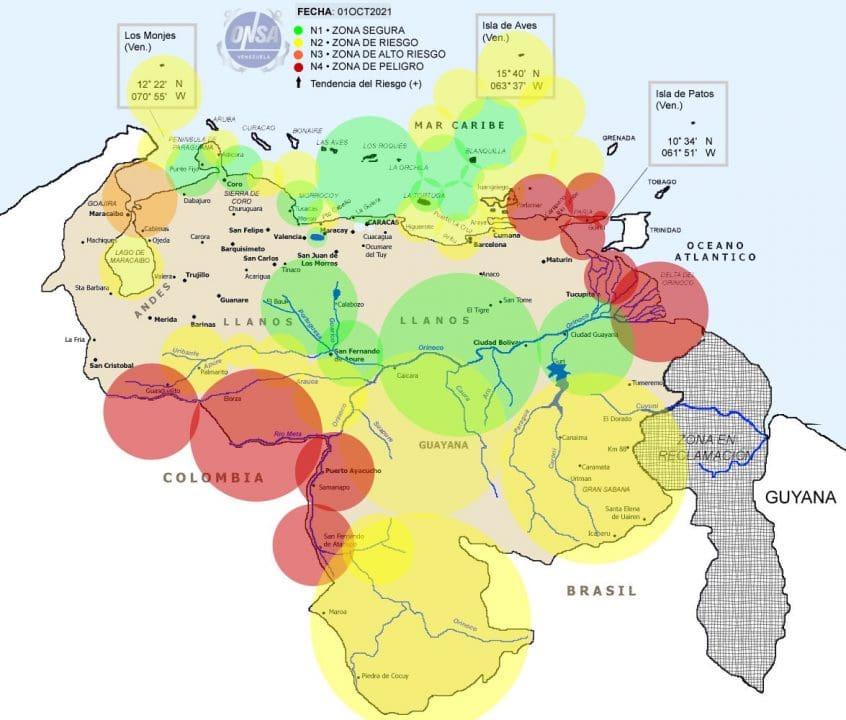
Source : CRONICA UNO
Are Venezuelan waters considered dangerous?
The IMO indicates that Venezuelan waters are navigable, and there has never been a warning not to navigate with them. It only indicates that in Venezuela navigability is open but under safety regulations. However, despite the above, Venezuelan waters are currently considered dangerous waters by marine insurers.
The hull and machinery marine insurance policies, which cover the vessel as insured property, provide within their clauses for certain areas to which the insured vessel cannot navigate, under penalty of losing coverage, unless notice is given to the insurer and that the latter accepts, with the corresponding increase in the premium, since normally, to navigate, in these areas, insurers require the contracting of a special war risk policy. This is because the aforementioned areas are considered dangerous as they are highly conflictive.
In recent years, a large number of policies have included Venezuelan territory as one of these dangerous areas in which the insured is prohibited from navigating without prior authorization. For the purposes of the policy, Venezuelan territory includes, in addition to its territorial sea, any offshore installations within its exclusive economic zone.
It is evident that the high rate of attacks on ships that have occurred in the Venezuelan aquatic space has led to Venezuelan waters being included as a dangerous area whose navigation requires a considerable increase in the premium.
Recent piracy cases in Venezuela
In September 2021, a Brazilian citizen named Favio Tavares Lugo was sailing from Panama to Brazil on the sailboat “Klinker”, when he was assaulted by 40 armed men, aboard four high-speed boats, on the coast of the Paria Peninsula, around midnight, when an emergency signal was issued from the sailboat. He was later found alive in Trinidad and Tobago. The assailants had demanded a payment of one hundred thousand dollars, which was probably made.
On March 21, 2019, three thieves armed with knives boarded an oil tanker that was anchored in the Port of Jose, Anzoátegui state. The assailants threatened a crew member with a knife and stole his radio. The alarm was turned on and the crew hid from the criminals. After this, the thieves escaped in a boat with their accomplices.
In addition, I have been aware of relatively large vessels, owned by former clients, that were dismantled while they were anchored in docks in Cumaná, Sucre State, that is, their navigation equipment was stolen, which is very expensive and represented a considerable economic loss. Unfortunately, these acts went unpunished.
I tried to collect news of piracy in Venezuela that occurred between 2023 and 2024, but without success, which shows how complicated it is to document piracy cases in Venezuela. As mentioned before, there has been a lack of formal reports of piracy cases in the recent years, since people are afraid of retaliation by the criminal organizations that carry out these crimes in Venezuelan waters.
Is Venezuela prepared to confront pirates at sea?
Taking into account the current situation in the Venezuelan waters, the need to propose strategies at the State level is evident in order to provide an urgent and efficient response, based on what is established in the national legal framework, specifically in the Organic Law of the National Bolivarian Armed Forces of Venezuela. In accordance with it, the Bolivarian Navy is responsible for the use of naval units to monitor, protect and defend our aquatic spaces and navigation routes. It is imperative to combat this scourge that is highly harmful to the economy and people’s safety.
Furthermore, cooperation should be sought with neighboring States that are also affected by this problem. Piracy is a global and also regional problem, so cooperation in this matter is necessary.
Conclusion
Piracy (actually, armed robbery against ships) in Venezuela has been a constant problem in recent years, which threatens the competitiveness of Venezuelan ports and, above all, the lives of seafarers, port workers, fishermen and even tourists.
The Venezuelan authorities must seek cooperation with neighboring States, such as Trinidad and Tobago, the Kingdom of the Netherlands through the Netherlands Antilles, Colombia, etc. At a global level, piracy has been reduced thanks to cooperation between States, and it could not be otherwise, since a global problem requires joint solutions, no State can end global piracy by itself. We can take this to the regional level and affirm that piracy in the Caribbean Sea can be combated more efficiently if the affected States join forces and resources; also, we should take into account that article 100 of UNCLOS establishes the duty of all States to cooperate to the extent possible in the repression of piracy.
Article written by Argenis Rodríguez


