


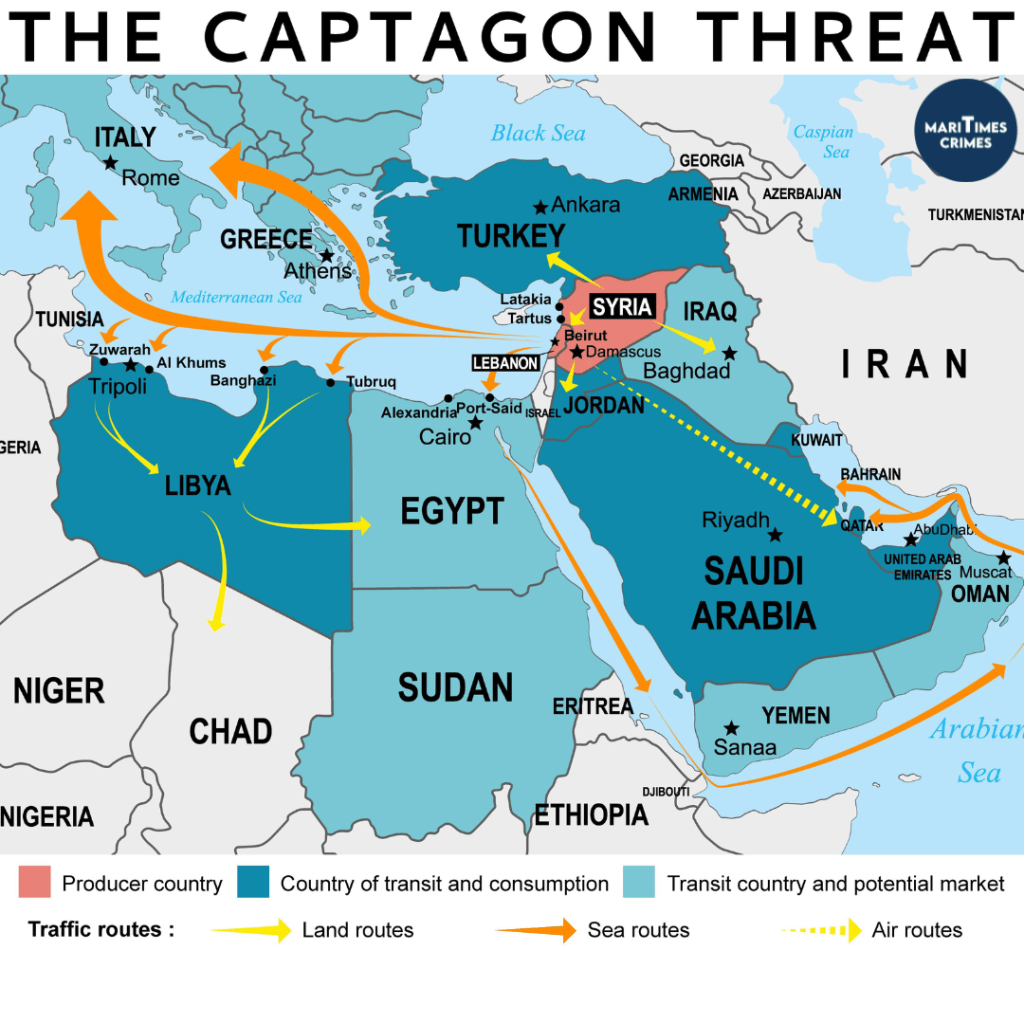
Last month, 18 million Captagon tablets were seized by customs in the Libyan port of Benghazi. In the Middle East, this drug is produced and sold by Bashar Al-Assad’s private network.
The three containers concerned were composed by fresh apples from the Syrian port of Latakia. The millions of Captagon tablets found inside were quickly destroyed by the security services of the port of Benghazi. First of all, the market covers all the Gulf States. Networks took charge of transporting shipments to the Arabian Peninsula, mainly from Lebanon. The rest of the world is also affected. It crosses seas and oceans. In 2021, Malaysia found 100 million tablets in its ports. In 2020, Italy discovered 14 tonnes in the port of Salerno, south of Naples.
This traffic is said to bring in more than 10 billion dollars a year. “For instance, 100 boxes will bring in 180 million dollars. The Saudi market is the strongest. We used to go from here to Dubai. Or from Syria to Jordan, then to Saudi Arabia.” Testify a local fixer to AFP.
The synthetic amphetamine-based drug costs $20 a pill. In Syria, its parent country, the pill costs just one. Nicknamed “the drug of terrorists” or “Daesh’s magic potion”, it is said to be used by jihadist soldiers in armed operations. As a powerful stimulant for the nervous system, it causes psychological and cardiovascular problems and intense hallucinations. Captagon can be recognized by its logo: two crescent moons, popularly known as “Abu Hilalain“, meaning “the one with the two crescents”.
Captagon market: the price of power
Captagon is the country’s main export, making Syria the world’s newest narco-state. This enables Damascus to stay afloat despite international sanctions and its isolation on the geopolitical chessboard.
Maher Al-Assad, the dictator’s younger brother and head of the Fourth Division, plays an
important part in managing this trade. “He takes a share of the Captagon profits, which are even used to partly pay the salaries of an armed group attached to the Fourth Division“, according to the head of the Syrian Observatory for Human Rights (SOHR), Rami Abdel Rahman. Elite unit accused of crimes against humanity, the Fourth Division partially controls the border with Lebanon, an essential trafficking territory. “It plays an active part in protecting, organising and manufacturing Captagon, and in transporting shipments to the ports of Latakia and Tartous“, according to Caroline Rose, an expert at the New Line Institute.
Around him, fifty barons, as well as terrorist groups, run the business, such as the Lebanese Hezbollah, supported by Iran. This wing protects smugglers in south-west Syria.
Since the country’s economic and security situation is not expected to change any time soon, Captagon trafficking, which is already present in Europe, Africa and Asia, is likely to increase over the coming years.


